Consumer Spec - Pre Market Wrap
AZO (-) Comps Miss, COST Dual PT Bumps, ROST $260, BOOT +5% QTD | BTIG Crude Breakdown Consumer Rebound, GS Bull Case, MS Tariff Pass-Through, DLTR Opco Checks (-), BJ Consumer, China Luxury Slowdown

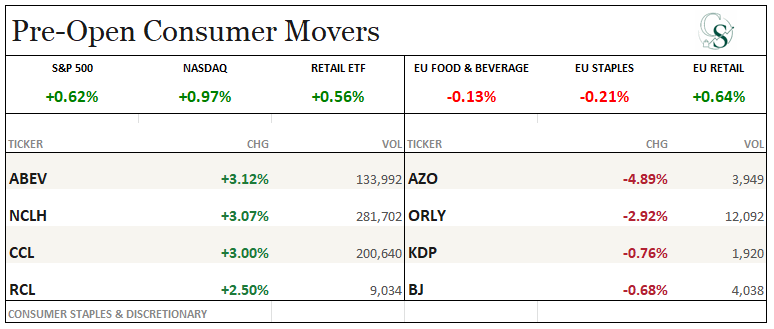
Consumer pre-market is quiet but would be interesting to see if there is rotation today into the sector considering Iran news. AZO is the early sore spot, off ~5% as domestic comps slipped to +4.1% against a stiffer buyside bar and OpEx ran hot. But the off-price and value cohort keeps humming — COST drew dual PT bumps (BofA $1,185, Oppenheimer $1,160) into Wednesday's print, ROST got lifted to $260 at Barclays, and BOOT is tracking +5% QTD versus its own +2-4% guide. Found interesting Opco negative channel checks on DLTR.
What we will cover:
Macro & Markets: interesting charts, key broker macro/market comments and BJ quotes on the consumer
Consumer Street Research
MACRO & MARKETS
INTERESTING MACRO CHARTS
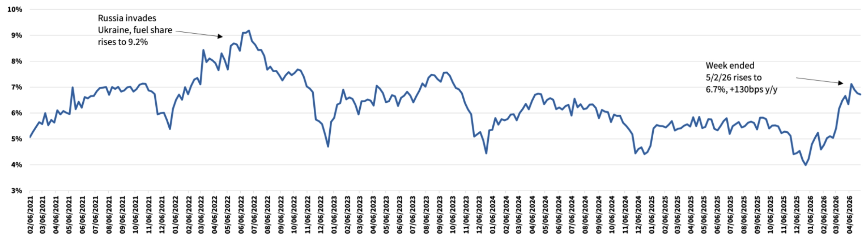
% of spend allocated to gas: still normal on historical standards
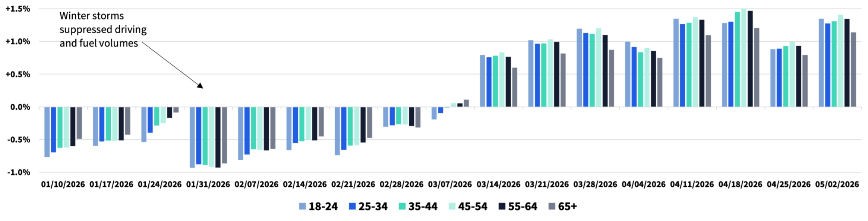
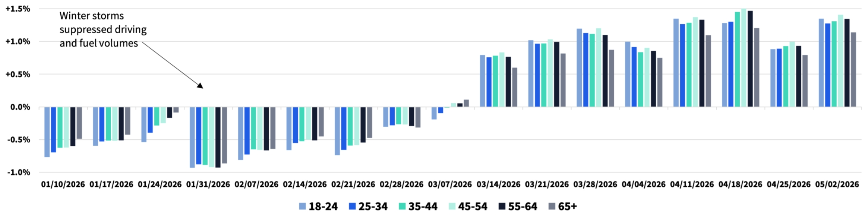
Consumer Edge US credit and debit card data. 7-day periods: overall spending look healthy
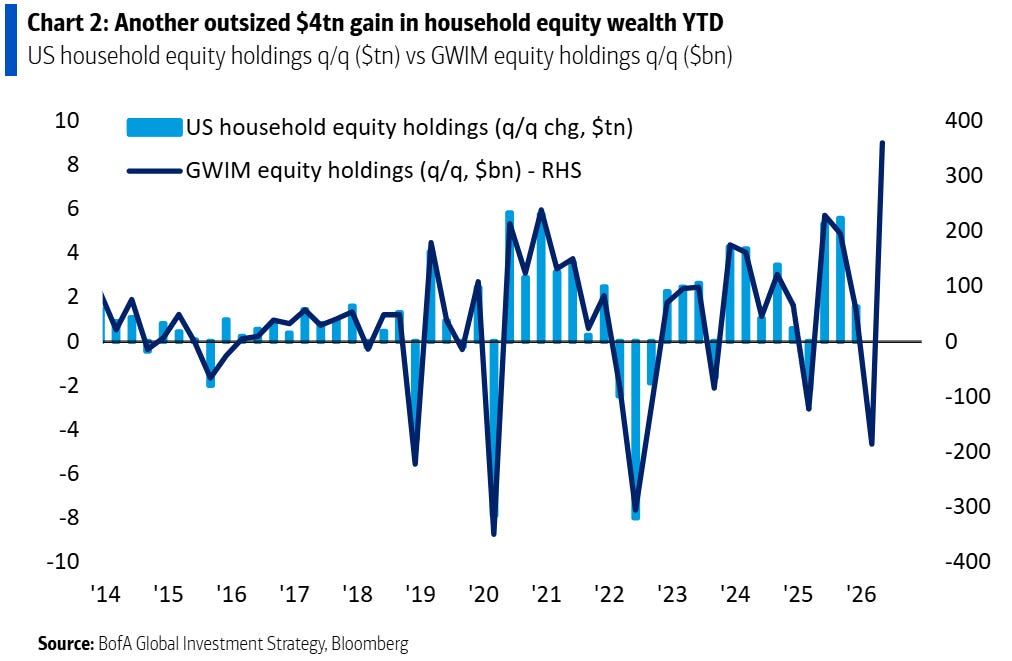
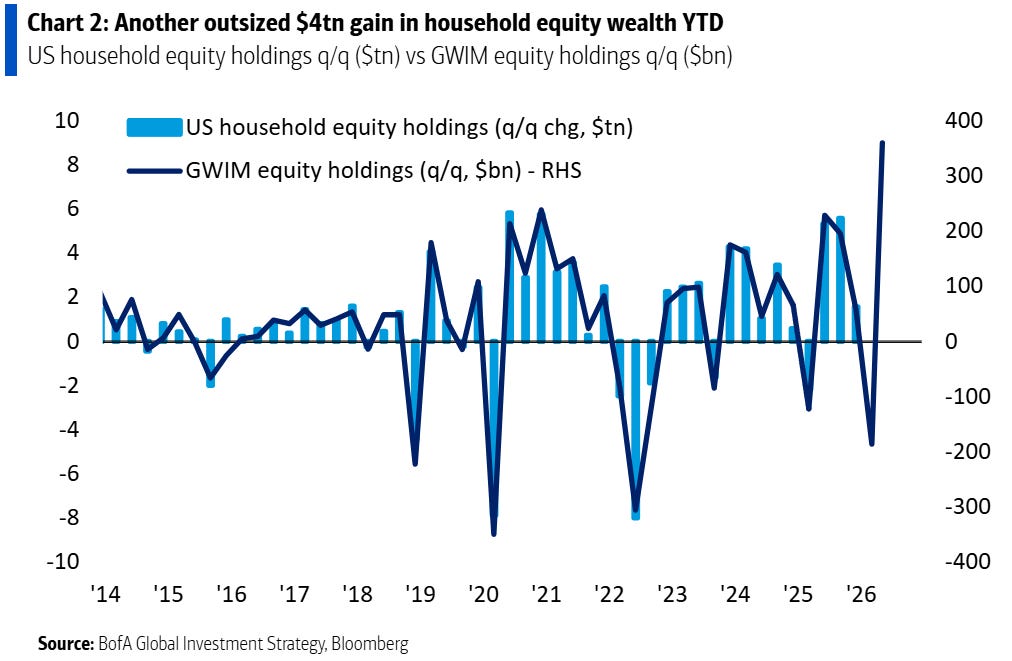
3. BofA Mike Hartnett writes: “US household equity wealth up $4tn YTD (using BofA private client equity holdings data - Chart 2); follows $10tn gain in '25, $9tn gain in '24, $8tn gain in '23…wealth key to US "boom loop", only ended by politics and bond
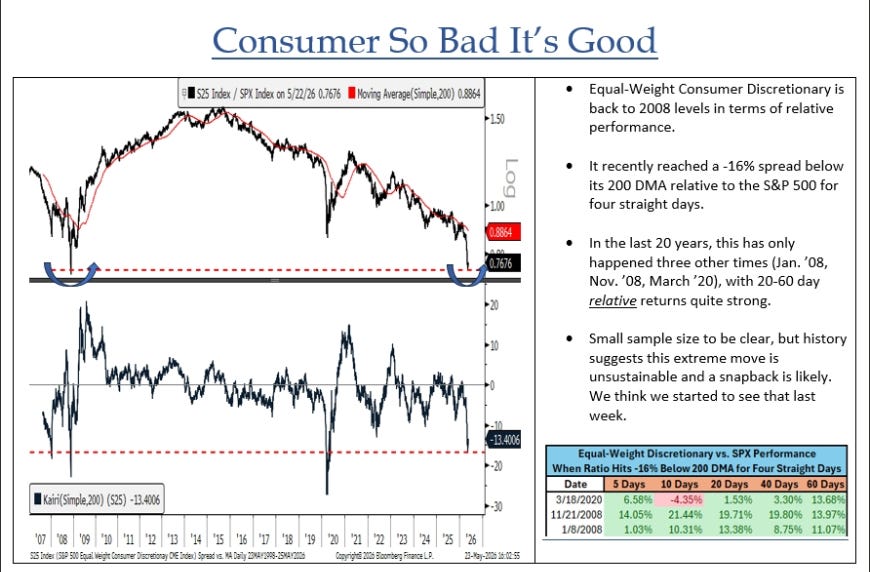
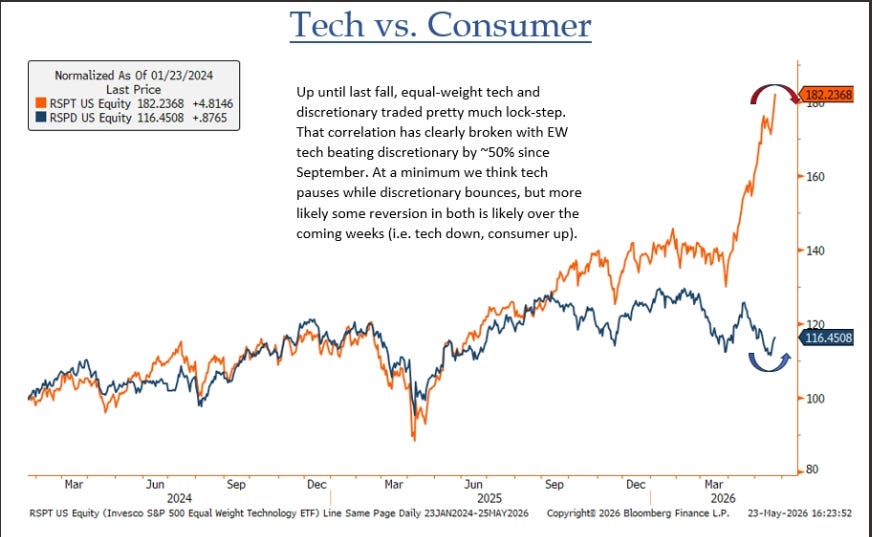
BTIG: CRUDE BREAKDOWN A LIKELY CATALYST FOR CONSUMER SECTOR REBOUND
The firm says equal-weight Discretionary is the worst YTD sector (-5.5%) on higher energy and rates, both poised for near-term downside, with relative performance back to ‘08 levels and a -16% spread vs its 200 DMA relative to SPX for four straight days, a setup seen only three times in 20 years (Jan ‘08, Nov ‘08, March ‘20) that preceded strong 20-60 day relative returns.
The analyst notes the tight Tech/Discretionary correlation has broken, with EW Tech outperforming by ~50% since September and the 30-day EW Tech vs EW Disc change (31%) matching the post-Covid-bottom 20-year high, while cap-weighted Discretionary sits at 2000 lows vs Tech. The firm adds that with WTI pulling back from ~$110 to ~$90/bbl and possibly lower, the consumer tailwind should intensify and could trigger both an upside reversion in consumer and a downside reversion in Tech/AI, flagging SOX’s new high without a 70 RSI as a negative divergence consistent with how tops begin.
Reversion candidates: CBRL (NR), DRI (Buy, PT $225), TXRH (Buy, PT $200), WING (Buy, PT $305), DKS (Buy, PT $300), CWH (NR), FUN (NR), NCLH (NR).
GOLDMAN TONY PASQUARIELLO: EQUITY BULL CASE INTACT BUT SUMMER SETUP TURNS TRICKIER
Tony Pasquariello, global head of hedge fund coverage at GS, says in a note to clients on Monday the primary trend remains higher, anchored by remarkably strong earnings (Q1 +26% y/y including “other income” from private holdings), an AI capex super cycle it argues has been “consistently underestimated in magnitude,” and supportive flows from US households and corporates. Pasquariello notes the local setup looks stretched, however, with the S&P up eight straight weeks, NDX printing one of its best 40-year short-cycle risk-adjusted returns, an aggressive grab for exposure via levered semi ETFs and short-dated calls on high-flying names, and a bond market moving in ways that typically intimidate equities. Pasquariello adds that realized vol should rise (extending from factor to index level) with elevated risk of two-way air pockets, favoring an up-in-liquidity bias to asset mix. Conclusion stays long delta / long vol, with equity length buttressed by shorts in global bonds.
MORGAN STANLEY : TARIFF PASS-THROUGH ENDING, POSITIVE FOR LOWER INFLATION
The firm says tariff pass-through is nearly complete (64bp of a forecasted 70bp through April), meaning the year-on-year inflation rate could fall up to 70bp if tariff-exposed goods revert to pre-Liberation Day trend, creating a high bar for oil and demand pressures to firm inflation and push the Fed to hike. MS notes investors agree on a resilient economy (real GDP 2.3%/2.6% 4Q/4Q in 2026/27) but disagree on inflation, with market pricing aligned to “permanent oil premium” and “aggregate demand” scenarios; base case sees headline/core PCE at 3.2%/2.8% this year and 2.0%/2.3% next, Fed on hold through year-end then 25bp cuts in March and June 2027.
The analyst adds that high-tariff goods were flat m/m in 2023-24 versus +0.22-0.25% since, leaving room for payback, while reflation bulls point to CPI software/accessories +13.9% y/y and memory feeding PPI computer equipment +8.1%. Separately, the firm flags financial conditions tightening ~35bp-equivalent since Feb 28 driven by higher 10y yields, the effective tariff rate falling to 8.3% in 1Q26, and 2Q GDP tracking nudged to 2.4%.
BJ WHOLESALE ON THE STATE OF THE CONSUMER & MACRO
State of the Consumer
Selective Spending: CEO Bob Eddy noted that “consumers across the country have digested meaningful inflation over the past few years,” leading them to “prioritize value in their purchases”.
Income Stratification: Eddy described the consumer landscape as bifurcated: “We’ve seen a resilient consumer, but... there’s considerable pressure on the lower-income consumers, and the middle-income consumers are trading sideways a bit, and the only real growth is from the affluent customers”.
Focus on Essentials: Management observed members consistently spending on “household essentials,” with “perishables, grocery, and sundries” delivering over 4% comparable growth, while “big-ticket, highly discretionary categories” like patio sets and outdoor sheds faced pressure.
Economic Outlook
Value as a Priority: CEO Bob Eddy emphasized that “consumers are always looking for value, but it’s paramount in challenging times like these”.
Inflation and Tariffs: Management expressed caution regarding the “uncertain and volatility in the macro environment,” specifically citing potential cost increases from supplier-passed tariff costs.
CONSUMER STREET RESEARCH
Upgrades
No consumer-sector upgrades today.
Downgrades
No consumer-sector downgrades today.
Initiations
No consumer-sector initiations today.
EARNINGS REPORTS
AZO -5% - COMPS SLIP ON A GEAR
Domestic comps +4.1% again light of a +5% buyside bar. Commercial +10.4% offsetting DIY, with International noted as below plan. With elevated +8.9% OpEx growth, investors demanding more top-line payoff. Shares likely to trade down today.
Options implied 4.5% move, Call 10am.
ANALYST RESEARCH
QSR — GUGGENHEIM RAISES PT TO 85, REITERATES BUY ON BURGER KING U.S. STRENGTH AND ATTRACTIVE 17.5X VALUATION
Guggenheim’s raised QSR target to $85 (from $80), reiterating Buy and lifting FY26/FY27 EPS to $4.00/$4.30 (from $3.95/$4.22). The bull case: recent performance reflects years of reinvestment, operational blocking-and-tackling, and marketing that resonates with guests, with Burger King U.S. “firing on all cylinders.” The bear offset: Gugg flagged 2H26 consumer macro pressures, particularly in Canada and overseas markets, and an oil-price shock risk to international results. On balance, firm argues that if international can hold up “OK,” RBI shares remain attractively valued at roughly 17.5x his 2027E EPS, supporting the higher target.
DLTR — OPPENHEIMER CHANNEL CHECK: PRICE CUTS UNWINDING AGGRESSIVE GROCERY HIKES, RATING PERFORM
Weekend store checks across DLTR locations ahead of Thursday’s Q1 call caught the retailer rolling select grocery SKUs back toward $1, including milk cut from $1.50 to $1.25 at one store and Lucky Charms ringing at $1 (discounted) versus a $1.50 shelf price at Hamburg Turnpike, though execution looks uneven across the fleet. The firm flags two competing explanations it can’t yet distinguish: management may have pushed grocery price increases too hard, or DLTR could be passing through tariff savings akin to what BJ’s signaled last week. The analyst notes consumer reaction to recent pricing appears to have come in below expectations per store observations, with a modest earnings reset already anticipated into the print, while store conditions, merchandising, and assortment across San Diego checks were described as solid and improving on both discretionary and consumables. Key open question for the call is what share of food assortment now sits at $1.50 and how early consumers are responding at that price. Rates Perform, no PT.
BOOT — JPM MGMT MEETING: QTD SSS RUNNING +5% VS +2-4% GUIDE, FY27 EPS UPSIDE TO $9.20-$9.65
JPM’s West Coast roadshow points to QTD SSS through 5/14 tracking +5% (April +5%, 1H May +5%), implying a 1Q comp of +4.7% against management’s +2-4% guide, with June comparisons easing 310bps versus May for a +6.1% comp opportunity to close the quarter. The firm pegs an FY27 EPS base upside case of $9.20, extending to $9.65 (+15% above guide midpoint) on a tariff-adjusted IEEPA-refund basis, well clear of the $8.57 Street and management’s $8.21-$8.64 range. The analyst flags the key conservatism as guidance embedding transactions flat to +1% for FY27 versus +2.5% observed 1QTD, a deliberate ~250bps haircut; if transactions merely hold, JPM sees FY27 SSS of +7.2%. The firm adds that operating margin leverage breaks even at a +3% comp and models +60-70bps of annual EBIT expansion at +7%, accelerating management’s 15% margin target to FY28 on high-single-digit comps, with FY28 upside EPS power flagged at $11.50+ versus $9.94 Street; at $154.65 the stock trades 15.6x CY27 EPS, a 0.6x PEG on the +25.6% two-year growth profile, PT $282 (~82% upside).
WMT — EVERCORE REITERATES OUTPERFORM, 140 PT; TRAFFIC GAINS AND WALMART+ SIGNUPS SIGNAL FLYWHEEL INTACT
Evercore ISI’s Greg Melich reiterated Outperform and a $140 target, arguing the post-print 10% selloff overlooked the positives. Drug and egg deflation cut comps 200bp and fears of broadening consumer pressure marred an otherwise solid Q1, but accelerating traffic, record Q1 Walmart+ signups, and a 12% variable margin in the $100B+ digital business show the “EDLC funds EDLP” flywheel intact. Walmart is reinvesting most of a 40-50bp U.S. EBIT margin tailwind into growth and passing along IEEPA tariff rebates to widen price gaps. FY27 guide reiterated with FX and tariff-refund cushion;
COST — BofA 3Q PREVIEW: REITERATE BUY, PO $1,185, K-SHAPED ECONOMY WINNER
The firm forecasts 3Q EPS of $4.96 (consensus $4.92) on total sales +12.1%, including a modeled 3% benefit from higher gas prices, with comparisons easing in May after several tough laps and QTD US comps (ex-gas) running +6.2%/+8.0% in March/April (7.7%/6.3% Easter-adjusted). Read-throughs from BJ and WMT earnings reinforce a value-seeking consumer with pressure on the low end but strength up-market, which the analyst says should benefit COST, while BJ’s gas margins came in line with expectations. The analyst models modest SG&A leverage as the company laps its wage agreement for 10 of 12 weeks (with a ~5bp one-time vacation-accrual headwind), supporting a 14% F2H EPS growth forecast despite a tougher core-on-core margin compare. The firm adds that with the last special dividend paid Jan ‘24 and a historical 2-3 year cadence, an announcement could land over the next few quarters; a repeat ~2.4% yield would imply roughly $25/share ($11.1bn vs current $17.4bn cash). COST’s value-led positioning and higher-income skew underpin conviction in continued share gains.
TPR — BARCLAYS REITERATES OVERWEIGHT, PT $179: “RETAIL COMPOUNDER” THESIS AFTER MGMT MEETINGS
Following 5/20-5/21 investor meetings in Stockholm and London with CEO Joanne Crevoiserat, CGO/President International Sandeep Seth, and Global Head of IR Christina Colone, the firm frames TPR as a structural grower rather than a cyclical retailer, built on five pillars: a self-renewing customer-acquisition engine with favorable cohort economics, an underpenetrated global market with disciplined expansion, structural pricing power without sacrificing volume, a data/AI-enabled operating model, and strong FCF with shareholder-aligned capital allocation. The analyst notes management is underwriting sustainable long-term growth and intentionally building a future-customer pipeline via a 50% increase in marketing spend skewed top-of-funnel, with early Gen Z and Gen Alpha acquisition (notably the $200-$500 sweet spot) supporting a mid-single-digit revenue floor and low-double-digit earnings growth. The firm maintains FY26/FY27/FY28 EPS of $6.97/$7.65/$8.48 vs consensus $6.97/$7.79/$8.62, with the PT held at $179 on 22x NTM P/E (above the Street’s 18.0x) applied to CY27 adj. EPS of $8.12, reflecting conviction TPR re-rates as it proves its competitive moat. The analyst adds the model is “in the flywheel,” with engagement funding marketing reinvestment and innovation alongside efficiency-driven margin expansion despite tariff headwinds.
SN — MORGAN STANLEY US SCANNER CHECK: LATEST 2-WK SALES +18.3% Y/Y, EQUAL-WEIGHT, PT $128
The firm’s all-channel US scanner data (including Amazon 1P and Costco) show SN sales up +18.3% y/y in the latest two weeks through 5/16/26 (+20.7% 2Y avg), roughly in line with +19.2% (+17.7% 2Y) in the prior period, while the L4W accelerated to +18.8% (+19.2% 2Y) from +11.2% prior. The analyst notes 2Q26-to-date scanner sales are up +16.2% y/y through seven weeks in the full-view database (vs +16.3% in 1Q) and +5.1% in the xAOC set (vs +4.8% in 1Q), cautioning this excludes potential sell-in/sell-through timing differences such as an earlier Prime Day. By category, L4W strength was led by coffee makers, other food makers, and toasters, with air cleaners and hair dryers declining over L4W. The firm estimates NielsenIQ now captures close to 80% of SN’s US demand following the Amazon 1P (early 2025) and Costco (December 2025) additions.
FRPT — MORGAN STANLEY PET SCANNER CHECK THROUGH 5/16: CATEGORY GROWTH MODESTLY BETTER, FRPT STRONG
The firm’s all-channel Nielsen US pet scanner data show YoY pet food category sales growth improving modestly sequentially in the latest four weeks, though the analyst notes growth remains highly disparate by company. FRPT growth was strong, while CL’s Hill’s food and CHD litter continued to perform well and gain share, and CLX continues to lose share.
COST — OPPENHEIMER RAISES PT TO 1,160 AHEAD OF MAY 28 PRINT; FLAGS FUEL-MIX RISK TO FISCAL Q3 EPS
Oppenheimer reiterated Outperform and raised its Costco target to $1,160 (from $1,100) ahead of the May 28 fiscal Q3 report, arguing the current consumer backdrop plays to the warehouse model’s “defensive characteristics” and value positioning across stores, e-commerce, and fuel. The firm sees upside from higher food-at-home inflation and possible catalysts including a special dividend or stock split. The bear caveat: fiscal Q3 EPS could miss the Street, with Oppenheimer modeling $4.75 versus consensus near $4.98 on temporary fuel, pharmacy, and e-commerce mix pressure. Shares are up 24% YTD versus the S&P’s 8%, now trading above historical valuation averages.
ROST — BARCLAYS RAISES PT TO 260, MAINTAINS OVERWEIGHT ON OFF-PRICE RETAILER ROSS STORES
Barclays’ Adrienne Yih raised her Ross Stores price target to $260 (from $242) while maintaining an Overweight rating, signaling continued conviction in the off-price channel’s positioning.
BOFA ASIA LUXURY : CHINA FIELD TRIP FLAGS MAINLAND SLOWDOWN, SPENDING SHIFT TO HK
The firm says Mainland China soft-luxury trends slowed to single-digit SSSG in 2QTD from >10% in 1Q (per MixC on April and Golden Week), and Apr-May Macau GGR decelerated from 1Q, partly on low VIP hold, with consumption shifting to Hong Kong on accelerating Golden Week mall trends, HK now ~12% cheaper than the Mainland on FX, and visitation +10% in April (down from +17% in 1Q).
The analyst notes jewellery saw a 1Q26 slowdown from gold price volatility, 2025 price hikes and VAT pass-through, but is showing early recovery as prices stabilize and players push premiumization, with HK more resilient than the Mainland. On watches, the firm adds Swiss exports to Greater China were -3% in 1Q26 (+8% FX-adjusted, -1ppt vs 4Q25), Emperor sees single-digit YTD growth led by watches, and brand polarization is acute with Rolex and Patek outperforming on better HK/Greater China allocation amid the Middle East conflict.
EARNINGS CALENDAR