
Consumer Spec - Pre Market Wrap
LULU (-) Comments | CMG JPM Upgrade, WMT MS/Erste Split, NKE Football Reset, PEP NA Deep-Dive, WING Loyalty Catalyst, TSCO VIP Petcare, BofA Sell Signal, Citi

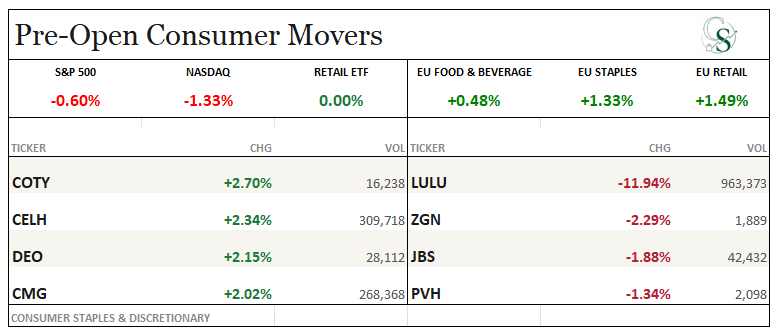
Consumer tape light in terms of new analyst notes, opening on a negative tone as yields move up after the labor report. Expect consumer sector to keep trading heavy until Hormuz clearly starts on a path to normalization. CMG is the only upgrade today — JPMorgan upgrades to Overweight after a 43% derate since May 2025, grouping the name with SBUX, CAVA, BROS as quality growth now reasonably priced.
LULU moves the other way: multiple brokers trim estimates post a disappointing 1Q26 and FY26 EPS cut. WMT downgraded at Erste on valuation. DG Bernstein PT raise to 149 on Q1 margin beat. TSCO PT cut despite Buy on VIP Petcare. WING Mizuho leans into 2H catalysts.
MACRO & MARKETS
BOFA FLOW SHOW FLAGS THIRD STRAIGHT SELL SIGNAL, B&B INDICATOR AT 8.7, JUNE CALENDAR LOADED WITH BINARY RISKS
Hartnett’s Flow Show (Jun 5) takes the B&B Indicator to 8.7 from 8.5, tripping a sell signal for the third consecutive week; the firm notes the 17 prior signals since ‘02 have averaged -2% to -3% for global stocks over 2-3 months with max drawdowns of 15-20%. Weekly flows showed $122bn to cash, a record $39bn into bonds ($20.1bn into IG alone, 2nd-largest on record) and $23.1bn into stocks, while US growth saw a $13.1bn outflow, the largest since Dec’25.
SPY, QQQ: JEFFERIES FLAGS POSITIONING AT +1.5 SD, CALLS FOR HEALTHY 4% RUSSELL PULLBACK, NOT A TOP
Jefferies leans on Vanda positioning data to argue the tape needs to breathe rather than break, with equity positioning crossing +1.5 SD (last seen pre-Oct pullback) and the SPX correlation to the indicator at 0.48; the firm notes the last 2.0 print was October, which preceded a drawdown. The analyst highlights Russell 2000 high-beta (Q5) up 55% QTD and YTD with rolling 12-month performance at the 92nd %ile, RUT forward P/E at 24.3x back to Nov ‘21 levels, and the absolute valuation model at the 90th %ile.
Jefferies adds the cheapest names are up <3% QTD versus the most expensive +33%, with the GARP rolling 12-month spread at just the 4th %ile, signaling momentum exhaustion. The firm keeps the bull case intact on fundamentals, citing earnings and sales revision ratios trending up, tight HY spreads, open capital markets and falling borrowing costs, and targets a ~4% Russell pullback toward year-end levels as a “pause that refreshes” rather than a structural small-cap fade.
BCA WARNS FED RISKS FUELING STOCK BUBBLE BY UNDERESTIMATING AI-DRIVEN INFLATION
BCA Research’s Peter Berezin pushed back on Fed Chair Kevin Warsh’s view that AI will lower inflation, calling the assessment wrong in the near term: AI is currently raising prices for everything from electricity to memory chips, while a buoyant stock market is encouraging households to spend more, adding further inflationary pressure. Standard theory — faster productivity growth, higher depreciation rates, and a rising capital share of income — argues against AI being structurally disinflationary. BCA sees two paths to AI lowering rates, neither welcome: a major AI capex bust, or a sharp rise in income inequality. The MacroQuant model flags stocks as overbought but not yet at imminent bear-market levels.
CITI BEAR MARKET CHECKLIST AT 10 OF 18 FLAGS, HIGHEST READING SINCE GFC
Citi’s Beata Manthey flagged the firm’s proprietary Bear Market Checklist at 10 out of 18 flags globally — the highest reading since the GFC. The U.S. registers 11.5, Europe 5. Citi notes the BMC has historically accelerated once it crosses into double digits. Contributing factors: stretched valuations, optimistic investor sentiment, elevated AI capex growth, and a pickup in IPO and equity issuance. Tight credit spreads remain a more constructive offset. The 2000 peak hit 17.5/18 and the GFC peak hit 13/18, so current conditions remain below prior bear-market levels. Citi stays constructive to year-end but warns that more flags turning on would argue dips should not necessarily be bought — relevant backdrop for cyclicals and discretionary names.
CONSUMER STREET RESEARCH
Upgrades
Chipotle (CMG) Raised to Overweight at JPMorgan; PT $35
Downgrades
Lululemon (LULU) Cut to Neutral at BTIG
Walmart (WMT) Cut to Hold at Erste Group
Initiations
No initiations in consumer today
EARNINGS REPORTS
LULU -11%: MODEL UNDER PRESSURE
Reported FQ1 EPS inline w/the Street at $1.69 as slightly higher sales (the Americas weren’t as bad as feared while int’l FXN growth undershot the Street by ~200bp) but weaker margins (gross margins sank 410bp while op. margins dropped 730bp Y/Y), and the full-year guidance is cut (they now see sales of $11-11.15B vs. the prior $1.35-11.5B w/EPS of ~$11.05 at the mid-point vs. the prior $12.20).
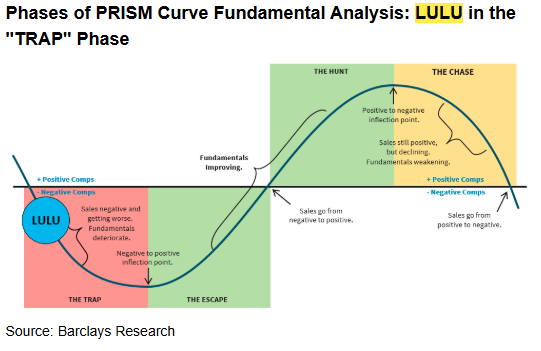
Barclays on the report, positioning the name in the worst part of a retailer phase:
We continue to view 2026 as LULU's "reset" year, with pressure persisting following a softer-than-expected start to the year and a lowered FY26 guide on both the top (-3%) and bottom (-9%) lines. 1Q26 trends softened late in the quarter and into 2Q26, driven by weaker product reception and negative brand commentary, which pressured traffic and top-line performance. The spike in negative brand commentary across media and social channels was seen across key markets including the U.S. and China, and primarily related to recent concerns around material composition and product safety.
1. Key Takeaways
NA biz is not stabilizing, it’s accelerating downward. Americas comps worsened sequentially for the fourth straight quarter to -6% cc. Q2 implies Americas LDD% declines, and FY26 now embeds Americas down HSD% (vs down 1-3% prior) with no assumed H2 improvement. US trends reportedly turned in late April and have extended through May. Canada cited slightly better than US.
Margin unwind is structural, not cyclical. Q1 GM -418 bps with 40 bps from markdowns; Q2 GM guided -410 bps with markdowns +50 bps. SG&A deleverage of 312 bps in Q1 reflects layering back store labor hours, incentive comp, and proxy battle costs that were cut last year. The prior “cost saves” never were structural. FY26 SG&A delev now +290 bps (vs +130 prior). FY26 EBIT margin cut to 16.1% from prior 17.4% guide, down ~770 bps from FY24’s 23.7%.
Productivity gap is widening. Store sales +3% on square footage +11% means sales per square foot meaningfully negative, which compounds fixed-cost deleverage and markdown risk as the chain keeps adding boxes into declining traffic. FY26 store plan: low end of +40-45 net new (15 N. America incl. 8 Mexico; 25-30 international, majority China).
New CEO transition adds another quarter of haze. Heidi O’Neill arrives September. Strategic reset, store growth review, and any potential rebase of LT targets are now post-September events. Mgmt explicitly noted “positive signals” in NA (Daydrift, Define, run franchises strong; away-from-body Align/Groove well received) but the “New Look of Yoga” halo did not materialize.
Tariff pressure mitigated, not the issue. Gross tariff impact cut to 30 bps for FY26 (from 90 bps prior), now fully offset via cost actions and full-price selling. Q1 GM bridge: tariffs -280 bps, markdowns -40, fixed-cost delev -140, offset by enterprise efficiency +100 and FX +60. Assumes 10% tariff rate in Q2 (vs 20% prior), back to 20% in H2.
China still the lone bright spot, ROW now on watch. China beat with growth +30% (+23% cc) on +13% cc comps (8pt CNY shift), FY guide reiterated +20%. ROW missed at +13% (+9% cc) on +1% cc comps due to Middle East impact; ROW guide of +mid-teens reiterated but appears increasingly store-driven, not comp-driven.
Marketing rebuild begins. Marketing planned +10-15% y/y to 6.0-6.5% of sales (from 5.6% in FY25), with mgmt acknowledging traffic needs a paid-media tailwind. Whether this is enough remains uncertain. FIFA World Cup tailwind possible: ~16% of Americas footprint sits in WC stadium markets.
Inventory remains controlled. Inventory +2% y/y on sales +4% in Q1 (best position ratio in 6+ quarters). FY guide +LSD-MSD% with units slightly down; mgmt leveraging chase capabilities to minimize markdown risk. Buyback authorization $1B remaining; similar y/y pace expected.
2. KPIs vs. Street
Revenue (Q1): $2.472B, +4% y/y (+2% cc; last q +1%) vs Street $2.430B (+3%) and high end of guide $2.43B. Light beat.
Revenue (Q2 guide): $2.450-$2.475B, down 2-3% y/y vs Street ~$2.595B / +2.7%. Material miss.
Revenue (FY26 guide): $11.00-$11.15B, -1% to 0% vs prior guide +2-4% ($11.30-$11.55B) and Street ~$11.47B. Cut by ~$300-450M.
Total Comps: +1% in Q1 (vs +3% in Q4 ex-53rd). Q2 guide implied -5% to -7%. No traffic/ticket split disclosed (data gap, but US weakness explicitly traffic-driven per mgmt).
Americas Comps: -5% reported (-6% cc) vs guide MSD% decline. Worsened from -1% (-2% cc) in Q4. Q2 implied -LDD%. FY26 embeds further deterioration.
China Comps: +13% cc (revenue +30% / +23% cc) with 8pt CNY shift benefit. Underlying ~+5%. Below the +25-30% guide; FY +20% reiterated.
ROW Comps: +1% cc (revenue +13% / +9% cc) vs guide mid-teens. Slowing trend continues; flagged as next narrative overhang.
Channel Growth: Stores +3% (vs flat ex-53rd in Q4), Digital +4% (vs +9% ex-53rd in Q4), Other +10%. DTC clearly losing share to digitally-native peers.
Price/Volume/Mix: Not explicitly disclosed (data gap). Mgmt cited full-price selling +HSD% in Q1, with FY plan slightly above that despite Q2 dip on markdowns.
Gross Margin (Q1): 54.2%, -418 bps y/y (vs guide -380 bps, Street -379 bps). Markdowns -40 bps (vs -30 guide).
Gross Margin (Q2 guide): ~54.4%, -410 bps vs Street ~-260 bps. Markdowns +50 bps.
Gross Margin (FY26 guide): ~55.7%, -90 bps (improved from prior -120 bps guide on lower tariff cost). Markdowns flat to slightly better y/y, implying H2 improvement that bears view skeptically given comp trajectory.
SG&A (Q1): 43.0% of sales, +312 bps deleverage vs Street +331 bps.
SG&A (FY26 guide): ~39.6%, +290 bps deleverage (vs +130 bps prior). Marketing +10-15% to 6.0-6.5% of sales.
Operating Margin (Q1): 11.2%, -730 bps vs Street -710 bps.
Operating Margin (FY26 guide): 16.1%, -380 bps (vs prior -250 bps guide). Down ~770 bps from FY24’s 23.7%.
EPS (Q1): $1.69 vs cons $1.68, guide $1.63-$1.68. Penny beat.
EPS (Q2 guide): $1.76-$1.81 vs cons $2.68. ~34% miss at midpoint.
EPS (FY26 guide): $10.95-$11.15 vs prior $12.10-$12.30 and Street ~$12.27. -17% y/y.
Inventory: +2% y/y in Q1 on sales +4% (clean). FY guide +LSD-MSD% with units slightly down.
Capex (FY26): $700-$720M (cut from $725-$745M).
3. Bull vs. Bear Debate
Bull Case. The bull thesis rests on three planks: (1) LULU is a category-defining brand with a still-massive international and category runway (men’s sub-30% of mix, footwear nascent, China at scale and growing 20%+); (2) the US issues are fixable with product cycles and marketing investment, both of which are now being aggressively re-engaged under fresh leadership; (3) the stock has been crushed (down ~63% from 52-week high of $338) and now trades at 11x FY26 / 9-10x FY27 EPS, a steep discount to historical averages of high teens and to athletic-apparel peers.
This quarter added marginal support to plank (1): China underlying growth ex-CNY still strong, inventory remains clean (+2% on +4% sales is best-in-class), tariff mitigation came in better than feared, and buyback capacity remains ($1B authorization). Newness penetration finally reached 30% (vs 23% LY), with mgmt citing run, Daydrift, and Define as resonating. The bull math: if FY27 EPS can hold the $11-$12 zone as US stabilizes and the new CEO’s strategic refresh lands in late FY26 / early FY27, the stock should re-rate to ~15-16x on the recovery, getting to ~$165-$200 (BTIG upside case is $200 at 16x ~$12.50; Jefferies upside is $150 at 13x $11.50). Pair: long LULU vs short premium-multiple lifestyle peers as a mean-reversion bet.
Bear Case. The bear thesis is now substantially reinforced: (1) brand momentum has clearly inflected negative with net purchase consideration turning negative for the first time, web/foot traffic underperforming peers (ONON, Vuori, Alo), and consumers signaling fatigue with the assortment; (2) the cost saves that masked weakness in FY25 are now reversing into the P&L, creating a double-whammy on margins as revenue simultaneously rolls; (3) store productivity (sales/sqft) is deteriorating because square footage is still growing +11% into a declining-comp Americas, which means the box-growth-as-growth-driver playbook is broken until productivity stabilizes.
This quarter added a substantial leg to the bear thesis. The Americas guide is now down HSD% for FY (from -1% to -3%), implying continued comp deterioration through 2H with zero assumed inflection. The Q2 EPS print at $1.76-$1.81 will be the second consecutive quarter of EPS down ~35-43%, and 2H markdown improvement (a key plug in the guide) looks optimistic given the comp trajectory. Mgmt’s “negative media” attribution sidesteps the harder diagnosis that product itself isn’t working at the scale it needs to. The bear math: FY27 EPS likely closer to $9-$10 (Jefferies $10, Raymond James $12.33, BTIG $11.26, downside cases $8.50-$8.60) at 9-10x trough multiple = $85-$100 (Jefferies downside $90 at 10x $8.60; BTIG downside $68 at 8x $8.50). A second cut to FY26 in Q2 is now a high-probability event, and the next leg of estimate cuts likely keeps the stock pinned through summer.
What Changed This Quarter. Three things. First, the US went from “decel risk” to “confirmed deterioration with no visible bottom” — Americas comps moved from -1% to -5% in a single quarter, and the FY guide assumes further deterioration. Second, the margin story moved from “self-help cost discipline” to “structural unwind” — SG&A deleverage tripled from +110 bps to +290 bps, and prior cost saves were revealed as temporary. Third, the bull catalyst path now requires a new CEO who hasn’t started yet (September), product cycles that have failed three years running, and a marketing rebuild whose ROI is unknown. The valuation discount is wider, but earnings power is also lower, so the “cheap” argument requires conviction that $11 EPS holds, which the trajectory does not yet support.
ANALYST RESEARCH & NEWS
CMG: JPMORGAN UPGRADES TO OVERWEIGHT, BUT TRIM PT TO 35 FROM 38
JPMorgan’s John Ivankoe upgraded CMG to Overweight from Neutral with a $35 price target (lowered from $38) following a 1x1 HQ visit with CEO Scott Boatwright and CFO Adam Rymer. The stock is down 43% since May 2025 vs. S&P up 29% and is back at 2021 levels. Ivankoe sees the multiple as fully re-rated to a more moderate — still well above average — growth profile, with at/below $30 offering more risk-weighted upside than downside. CMG joins SBUX (large cap), CAVA/BROS (mid cap), and SG (small/micro) on JPM’s “quality growth at the right price” list. Waning consumer confidence (Michigan -8% y/y) is the cyclical pushback, but valuation compensates.
WMT: MS REITERATE OW, $140 PT, 2Q TRACKING IN LINE, ECOMM FLYWHEEL INTACT
The firm hosted senior management at WMT’s Annual Associates & Shareholders’ Week in Bentonville and came away constructive on four fronts. Tariff refunds will be redeployed into price rollbacks but smoothed across multiple quarters rather than concentrated, preserving an even earnings cadence, while the analyst notes 2FQ27 is tracking at least in line with internal expectations as weather-soft late-April categories rebounded into hotter weather. The eComm flywheel of membership, advertising, and marketplace continues spinning fast, anchoring share gains and operating leverage. On grocery, the analyst flags intensifying competition but views WMT’s already-wide price gaps as a competitive moat economically unfeasible for most peers to close.
NKE: JEFFERIES GLOBAL FOOTBALL INVESTOR EVENT TAKEAWAY, NEXT PROOF POINT POST RUNNING, CONSTRUCTIVE INTO WORLD CUP
The firm attended NKE’s Global Football investor event in NYC hosted by VP Corp Finance & Treasurer Paul Trussell and Global Football GM Camilo Andrade, framing Football as the next coordinated category reset following Running, which was up >20% last quarter and established the playbook. The analyst highlights tangible product innovation anchored by the Aero-FIT platform spanning Mercurial, Phantom, Tiempo, and Vapor cleat tiers, paired with a full-funnel “Rip the Script” storytelling campaign, a 12-week activation cadence, and elevation of ~6,000 wholesale and owned doors. World Cup is being positioned as a multi-year growth engine across footwear, apparel, and sportswear rather than an event-cycle pulse. The firm remains constructive but flags uneven execution in China, Europe, and DTC, with a full earnings recovery more likely building into F’28.
PEP: WELLS REIT EW, PT CUT TO $150 FROM $159 ON 17X CY27E, NA DEEP-DIVE DRIVES ESTIMATE CUTS
In a deep-dive on PEP’s NA business (~58/62% of sales/EBIT), Wells lowered Q226/2026 org sales to +1.3%/+1.9% (from +3.1%/+3.3%) vs. Street +3.0%/+3.1%, and trimmed Q2/2026/2027 EPS by 4c/6c/18c to $2.14/$8.50/$8.76, or -3%/-1%/-4% vs. Street. PFNA Q226 orgs now modeled at -1% (was +2%) vs. Street +1%, with the analyst flagging positives in top-category volume inflection, Simply NKD innovation, and flavored outperforming unflavored, offset by a slower category, worsening price on channel mix (food/drug/conv softer vs. club), and small innovation with decelerating Siete contribution. PBNA Q226 orgs cut to -1% (was +2%) vs. Street +2%, with brand Pepsi still positive on a 2-yr stack (Pepsi Max/Zero strong, Mountain Dew ~flat off 2025 lows) but underperformance vs. category at the widest in at least four years driven by soft drinks. PT moves to $150 on 17x (from 18x) lower CY27e EPS; the analyst adds the stock is not expensive but the path to accelerating 2026 sales remains tough to underwrite.
WING: MIZUHO REITERATES OUTPERFORM, 280 PT ON LOYALTY LAUNCH AND WORLD CUP SSS CATALYSTS
Mizuho’s Nick Setyan reiterated Outperform and a $280 price target on WING, calling EV/’27 EBITDA of 16x a decade low. The note focuses on underappreciated near-term catalysts: checks point to a sentiment inflection in store-level conditions into late Q2 and 2H, helped by a more competitive value posture, a more action-oriented TV campaign, and renewed focus on core urban, lower-income customers through the loyalty launch. Loyalty alone is estimated to add >3% to SSS, with the World Cup another 0.5–1.5% in Q2/Q3. Mizuho still sees a mid-teens%+ system sales and 15%+ EBITDA growth algorithm — 3–4x franchised peers — supporting the 150% peer premium (vs. 190% historical).
WMT: ERSTE DOWNGRADES TO HOLD ON STRETCHED VALUATION RELATIVE TO EARNINGS GROWTH AND PEERS
Erste Group downgraded WMT to Hold from Buy, citing a stretched valuation against an only modestly accelerating earnings profile. Management’s FY outlook calls for sales growth of around 4% and operating profit growth of around 8.5%, with EPS guidance unchanged in the $2.75–2.85 range. Engel argues the P/E is now too rich relative to expected earnings growth, including in comparison to retail peers, limiting further upside potential from current levels. The note is more valuation-driven than fundamental and reads as a yellow flag rather than a thesis change.
TSCO: GUGGENHEIM LOWERS PT TO 50 FROM 60 ON VIP PETCARE DEAL
Guggenheim’s Steven Forbes lowered the TSCO price target to $50 from $60 while maintaining a Buy on the recently announced acquisition of VIP Petcare, the largest U.S. mobile veterinary care provider. Forbes views the deal favorably given likely deal leverage — TSCO already houses VIP Petcare or PetVet community clinics across ~1,700 of its locations (~63% of the 2,700 national/regional retailer footprint) — and sees revenue and cost synergies when combined with Allivet’s pharmacy capabilities. Roughly 75% of TSCO customers own a dog and more than half own a cat, opening a sizable services runway that could be folded into the Neighbor’s Club loyalty program, potentially as part of a paid membership offering.
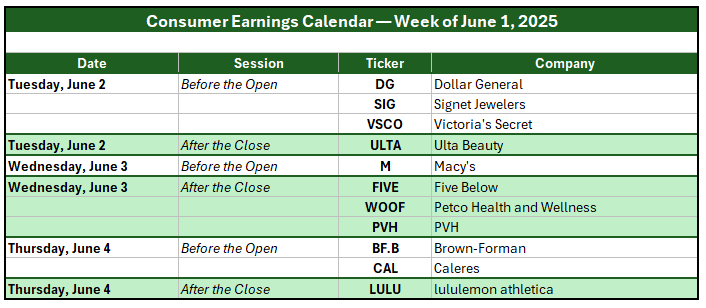
EARNINGS CALENDAR
Great content!