
Consumer Spec Pre-Market Wrap

U.S. equity futures are barely budging Monday morning — S&P -8bps, Dow -11bps, Nasdaq +3bps, Russell flat — as investors digest the cancelled U.S.-Iran face-to-face in Islamabad and brace for one of the busiest catalyst weeks of the year. Brent is ripping ~2.5% to ~$108, fully recouping its post-ceasefire slide, while the 10-year sits stubbornly near recent levels and the dollar slips another 25bps. Tehran has now floated a Hormuz-first negotiating framework, which Washington will likely reject since the blockade is its key leverage on the nuclear file. Attention turns to the BOJ tonight, FOMC Wednesday, and ECB/BOE plus Q1 GDP and March PCE Thursday — all before mega-cap tech (AMZN, GOOGL, META, MSFT Wed; AAPL Thurs) closes the week. On the consumer tape, P&G's $1B oil-cost warning is the one to watch — pricing is coming.
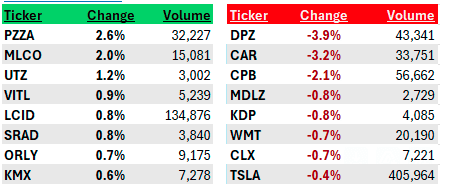
Consumer pre-market feels quiet but uneasy with restaurants and packaged food sitting on the wrong side of sentiment — DPZ down 4% after a clear top-line miss, U.S. comps at just +0.9% versus the +2%+ Street wanted, raising real doubts about that 3% full-year bogey. CPB downgraded at Bernstein who finally waved the white flag on Soup and Cape Cod share losses. Honestly, the staples bull case is getting harder to defend here. Bright spots: PG double PT raise (Wells, Jefferies) though oil at ~$100 means more pricing coming, WSM Goldman defending Buy, ROST PT to $290, MGM Vegas RevPAR quietly accelerating to +20% in March. Yardeni calling March 30 the bottom — bold.
STREET RESEARCH:
Upgrades
None
Downgrades
Campbell’s (CPB) Cut to Market Perform at Bernstein; PT $21
Initiations
None
EARNINGS REPORTS:
DPZ -4%: Q1 Miss Pressures 2026 Guidance as Weak Comps Overshadow Strong Unit Growth, Buybacks, and Share Gains
Domino’s reported a softer-than-expected Q1, with adjusted EPS of $4.13 missing Street estimates of roughly $4.26-$4.27, driven mainly by weaker same-store sales in both the U.S. and international business. U.S. comps rose just 0.9%, well below expectations near 2%-2.5%, while international comps declined 0.4% versus forecasts for modest growth. The main investor concern is that this weak start puts pressure on Domino’s prior full-year target of about 3% U.S. same-store sales growth, especially since management had previously expected first-half performance to be stronger than the second half. On the positive side, global net store openings were better than expected, supply chain margins were solid, and the board authorized an additional $1 billion share repurchase program. Still, company-owned store margins were notably weak, and operating income benefited from a one-time gain on the sale of a corporate aircraft. The key near-term focus is whether management lowers 2026 guidance.
Key positives: global net store openings were better than expected, with 180 net new units and international development ahead of forecasts, showing the long-term expansion story remains intact. Supply chain margins also came in better than expected, helped by procurement productivity, and the board added a new $1 billion share repurchase authorization, which supports capital returns. Domino’s also indicated it continued to gain domestic market share, an encouraging sign in a difficult pizza category.
Key negatives: the quarter missed where investors cared most. Adjusted EPS came in at $4.13 versus expectations around $4.26-$4.27, U.S. same-store sales rose only 0.9% versus expectations above 2%, and international same-store sales declined 0.4% instead of posting growth. Company-owned store margins were much weaker than expected, and the report raises concern that Domino’s may struggle to achieve its prior full-year U.S. same-store sales guidance of about 3%, especially since management had expected the first half to be stronger than the second half.
Key take: This was driven by a top-line miss, with both U.S. and International same-store sales below expectations, in addition to company-store margins. Domestic comp miss was largely anticipated by investors, though the international SSS and magnitude of the earnings misses were perhaps greater than expected.
Analyst Actions
PG: PROCTER & GAMBLE PT RAISED TO 164 AT WELLS FARGO AND TO 177 AT JEFFERIES
Wells Fargo analyst Chris Carey raised his price target on Procter & Gamble to $164 from $158, maintaining an Overweight rating. Separately, Jefferies raised its price target on PG to $177, maintaining a constructive view on the consumer staples bellwether. The dual broker increases come ahead of upcoming results and reflect improved confidence in the company’s pricing power and brand portfolio resilience amid a more inflationary backdrop. PG remains a defensive cornerstone for many consumer-focused portfolios, and the back-to-back PT raises suggest the sell-side is becoming incrementally more bullish on near-term execution and capital return capacity.
KDP: KEURIG DR PEPPER PRICE TARGET RAISED TO 30 DOLLARS AT BARCLAYS MAINTAINING POSITIVE STANCE
Barclays raised its price target on Keurig Dr Pepper to $30, signaling continued constructive sentiment on the beverage maker ahead of upcoming earnings. The move comes within a broader Barclays consumer staples revision cycle that included PT changes across multiple food and household names. KDP continues to benefit from its diversified beverage portfolio spanning carbonated soft drinks, coffee, and water, with management focused on disciplined pricing and mix to navigate input cost pressures. The PT raise suggests the sell-side sees room for multiple expansion as KDP delivers on its commercial agenda.
CPB: CAMPBELL’S DOWNGRADED TO MARKET PERFORM AT BERNSTEIN ON SOUP AND SNACK MARKET SHARE LOSS
Bernstein SocGen analyst Alexia Howard downgraded Campbell’s from Outperform to Market Perform with a price target cut to $21 from $27. Howard “waved the white flag” on her May 2024 upgrade thesis, citing underperformance in Soup, ongoing challenges in Cape Cod and Kettle potato chips, and middling Pepperidge Farm results. The flagship Campbell’s brand has recovered share in Condensed Soup, but the subcategory itself is in decline. Cape Cod and Kettle have been losing share to PepsiCo and Utz, while Snyder’s pretzels have seen over a year of declining volumes. Management’s price reductions on Cape Cod and innovation pipeline for Kettle remain show-me stories.
WSM: GOLDMAN SACHS MAINTAINS BUY ON WILLIAMS-SONOMA WITH $218 PRICE TARGET DEFENDING UPGRADE
Goldman Sachs analyst Kate McShane reiterated a Buy rating on Williams-Sonoma with a $218 price target, defending her April 13 upgrade against pushback on valuation, margin expansion potential, and Pottery Barn’s Q4 underperformance. McShane’s bull thesis is predicated on top-line momentum driving positive earnings revisions, citing consistent improvement at West Elm, increased newness in FY26 including the late-April Dormify launch, and an underappreciated return to unit growth. NPI and NPS scores are improving across all WSM brands, and the Emma Chamberlain collection launched strongly. Goldman views the recent ~14% pullback from February highs as an opportunistic entry point into the home furnishings name.
ROST: ROSS STORES PRICE TARGET RAISED TO $290 AT GUGGENHEIM ON CONSTRUCTIVE OFF-PRICE OUTLOOK
Guggenheim analyst Simon Siegel raised the price target on Ross Stores to $290 from $226, maintaining a Buy rating. The substantial 28% PT increase reflects growing constructive sentiment on the off-price retail channel, where Ross continues to capitalize on consumers trading down and seeking value. Off-price retailers have remained resilient through varying economic conditions, with their treasure-hunt format and disciplined inventory management providing a defensible moat against both traditional retailers and e-commerce. The PT lift suggests the Street sees continued comp momentum and margin durability for Ross through the remainder of 2026.
ORLY: O’REILLY AUTOMOTIVE ADDED TO EVERCORE’S TACTICAL OUTPERFORM LIST AHEAD OF EARNINGS
Evercore ISI analyst Greg Melich added O’Reilly Automotive to the firm’s Outperform Tactical Trading List, reiterating the existing $110 price target. Melich believes a favorable and rational backdrop should support a modest beat on the quarter while management maintains FY guidance that bakes in a “stair of despair” allowing for easier hurdles through 2H26. The stock has traded modestly below the S&P YTD versus peers AZO up 6% and AAP up 50%. He sees pricing upside to mitigate higher input costs and models 1Q comp of +5.8% versus Street at +5.5%, with EPS of $0.71 a penny ahead. For FY, Evercore stays above the high end of $3.10 to $3.20 guide at $3.30.
MGM: MGM RESORTS PRICE TARGET LOWERED TO 59 AT MIZUHO REMAINING OUTPERFORM ON VEGAS RECOVERY
Mizuho analyst Ben Chaiken lowered his price target on MGM Resorts to $59 from $62 while maintaining an Outperform rating. Chaiken continues to find shares compelling on improving underlying trends and a compelling event path against negative sentiment and low expectations. Recent Vegas RevPAR acceleration is being overlooked: 3Q Vegas MGM RevPAR was -8%, 4Q was -10%, but January market-wide was +4.5%, February was +6.2%, and March is likely +20%. The only near-term concern is that April likely looks soft, but Chaiken attributes this more to Easter comparisons than fundamental weakness, which could take air out of the recovery trade for a few weeks.
CWH, PATK, THO, WGO: RV March wholesale shipments fall 13.9% year-over-year as towables weaken sharply while motorized units post gains
RVIA reported March wholesale RV shipments of 32,162 units, down 13.9% y/y and softer than normal seasonal trends following an in-line February. March typically rises mid-teens % sequentially, but this month grew only low-double-digits. Paired with an estimated retail decline of 15% y/y, roughly 5.5K units were restocked—above the normal March pace of 3.8K. Motorized units rose 9.3% y/y, led by Class C (+15.9%) and Class B (+4.9%), while Class A fell 7.3%. Towables dropped 16.2% y/y, with travel trailers (-17.3%), camping trailers (-18.8%), and fifth wheels (-12.8%) all weak; truck campers bucked the trend at +11.3%. Tickers: CWH, PATK, THO, WGO.
QXO: KEYBANK RAISE PT TO $32 on accretive pending $17B TopBuild acquisition and pro-forma model update
KeyBanc turned incrementally positive on QXO following its announced ~$17B acquisition of TopBuild on 4/19/26, viewing the deal as accretive and a springboard to the top position in North American insulation distribution and installation. The combination brings industry-leading margins, strong FCF conversion, and cross-sell opportunities across customer and vendor relationships. Updated pro-forma 2030E estimates rise meaningfully to $35B revenue, $5.5B adjusted EBITDA, and $3.7B FCF, with leverage modeled at 3.6x at close declining to ~2.5x. Near-term 2026 quarterly estimates were trimmed on macro headwinds. The price target rises from $30 to $32, applying a conservative 14x EV/EBITDA multiple discounted at 8%.
MACRO & NEWS
MARKETS: YARDENI DECLARES MARCH 30 LOW AS YEAR’S BOTTOM REITERATING 7,700 S&P TARGET FOR 2026
Yardeni Research declared the March 30 low marks the bottom for stocks this year, reiterating a year-end S&P 500 target of 7,700. The firm drew a parallel to the 1956 Suez Crisis, when canal closure sent crude prices higher and the Dow fell ~10% before recovering to new highs. Yardeni noted geopolitical oil supply shocks have historically been buying opportunities for stocks, with the 1970s as the exception. Iran’s Strait of Hormuz blockade and U.S. Iranian port blockade remain in place after weekend Islamabad peace talks failed. Base case calls for the S&P to chop around 7,000 while the stalemate holds, then grind higher in 2H toward 7,700, assuming a mid-year deal. S&P 500 forward EPS hit a record $344.30, with 82.6% of companies showing positive forward earnings growth