Consumer Spec - Pre Market Wrap
NCLH (-) FY26 Cut, TSN (+) Beat | Cruise Complex Read-Through, Packaged Food Pressure (CLX, HSY, TAP), VITL Gutted, EL Beauty PT Raises, WMT+ Membership High, ONON Short Thesis, PKG Upgrade, Auto SAAR

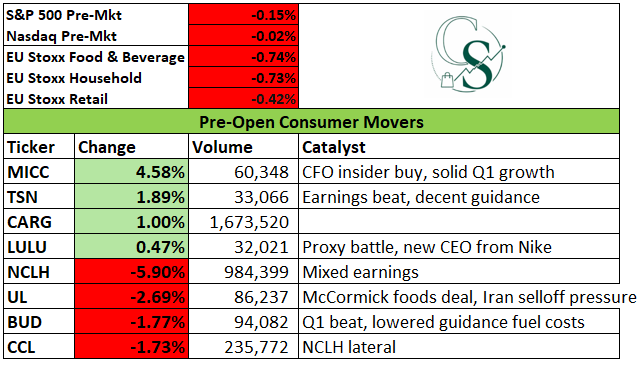
Futures slightly lower, with the S&P 500 down 15bps and Nasdaq down 10bps after both indices hit all-time highs on Friday, while the 10-year Treasury yield rose to 4.405%, WTI crude surged nearly 3% to $105, and gold dipped 1.1% to $4,560. Weekend headlines were dominated by escalating U.S.-Iran tensions after President Trump launched "Project Freedom" to guide neutral ships through the Strait of Hormuz, and a false report of missiles hitting a U.S. warship was quickly refuted by officials.
Consumer Pre-Market
Consumer pre-market is mixed but leaning cautious — cruise lines taking the brunt as NCLH slashes FY26 EPS guide to $1.62 midpoint vs. $2.12 Street, citing Middle East disruption and softer European bookings, with negative read-through risk to CCL, RCL and VIK. Packaged food remains under pressure: Barclays cuts CLX -17% to $85, trims HSY and TAP, while VITL gets gutted to $16 from $47 on egg supply pressure. Bright spots: TSN beats by 9c, EL draws three PT raises despite tepid organic growth, WMT+ hits all-time membership high. Honestly, the GLP-1 weight-loss wave plus tariff fog makes bottom-fishing in staples feel premature — stay selective.
STREET RESEARCH
Upgrades
N/A
Downgrades
Vital Farms (VITL) Cut to Neutral at DA Davidson
Initiations
Hain Celestial (HAIN) Rated New Neutral at Mizuho
Earnings
TSN +1.3%: TYSON TOPS Q2 EPS BY 9C SEES FY26 SALES UP 2 TO 4 PERCENT
Tyson Foods reported Q2 EPS of $0.87, beating consensus of $0.78 by $0.09. Revenue of $13.65B came in slightly ahead of the $13.61B Street estimate. Management guided FY26 sales growth of +2% to +4%. Trends were mixed: volumes declined (-2.3%) but pricing rose (+4.1%), with strong chicken performance offset by losses in beef and weaker pork. Guidance was modestly improved, with op income raised to $2.2B–$2.4B vs cons $2.22B, while rev growth of +2–4% was maintained. Overall, pricing remains the key driver given uneven demand and continued segment volatility. Options implied 5% move. Call 9am
First impressions from Barclays:
TSN reported better than expected results, as strength in Chicken and Prepared Foods almost entirely offset YoY weakness in Beef. Raises guidance by $100mn mainly due to a $200mn increase in Chicken - offset by a mid-point $100mn reduction in Beef. Stay OW
NCLH -7% : GUIDANCE CUT WORSE THAN EXPECTED AND OVERSHADOWING A Q1 BEAT
Result recap: NCLH beat 1Q on EBITDA/EPS but slashed FY26 yield and EBITDA guide materially, with 2Q guide also well below — clearing event or another shoe to drop.
Hearing frustration on this management:

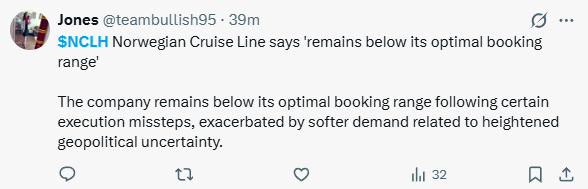
1Q26 EBITDA $533M, +18% y/y vs Street $505M and guide $515M; net yield (CC) -1.0% vs guide -1.6% and Street -1.6%. EPS $0.23 vs Street $0.14, guide $0.16. But FY26 yield guide cut to -3% to -5% (prior ~flat) vs Street -0.3% to -0.8%, with FY26 EBITDA now $2.48-$2.64B (mid ~$2.56B) vs Street ~$2.81-$2.83B — implying ~32% EPS cut at midpoint to $1.45-$1.79 vs Street $2.09-$2.10. 2Q EBITDA guided $632M vs Street $697-$706M. Mgmt blamed fuel, Middle East disruption, and softer European bookings (NCLH sources 100% US guests for Europe, ~26% of 2Q capacity in Europe vs 38% in 3Q), and announced a $125M annualized G&A cost-out program plus a $100-$200M/yr capex bump for 2026-2028.
1. Key Takeaways
FY26 guide cut is the story, not the 1Q beat. Net yield guide moved from ~flat to -3% to -5% (Street was -0.3% to -0.8%); EBITDA midpoint $2.56B vs Street ~$2.83B. Implied 2H yield -3.4% to -7.2%, with implied 3Q yield ~-7% (Street had -1.9%) and implied 4Q now negative vs prior expectation of up LSD.
Europe is the epicenter. Geopolitical/Middle East disruption hits NCLH disproportionately given 100% US-sourced Europe guests; mgmt also flagged softer European bookings broadly. NCLH was already behind the booking curve heading into the year.
Customer deposits/deferred rev -1% y/y on capacity +7.5% — a deceleration from last print and a leading-indicator negative on closer-in pricing/onboard.
$125M G&A cost-out is a partial offset (NCC FY guide moved from +90bps to flat, ~90bps benefit) but doesn’t move the needle vs the topline miss. Risk that cuts hit advertising/marketing in a softer demand backdrop.
Capex guide raised $100-$200M/yr in 2026-2028, pressuring FCF and the deleveraging path. Net debt/EBITDA still 5.3x (unch q/q); YE26 leverage target ~5.2x is now harder math given lower EBITDA.
Itinerary chop beyond Europe: Open Jaw, Alaska, legacy Caribbean, Bermuda/Philly — shorter Caribbean itineraries drove revenue per passenger -15% y/y.
Read-through risk: RCL had been read positively into NCLH; this print breaks that thread and reasserts NCLH-specific exposure.
2. KPIs vs. Street
Adj. EBITDA (1Q): $533M, +18% y/y vs Street $505M, guide $515M. Beat.
Net Yields CC (1Q): -1.0% vs Street -1.6%, guide -1.6%. Beat. Onboard yields -0.3% y/y (vs -0.2% last q), or -2.5% per occupied berth day (vs -1% last q) — onboard decelerating.
NCC ex-fuel CC (1Q): -1.0% vs Street -0.8%, guide -0.8%. In line.
Adj. EPS (1Q): $0.23 vs Street $0.14, guide $0.16. Beat (lower interest expense helped).
Occupancy (1Q): 103.8% vs guide ~104.2%. Slight miss.
2Q26 EBITDA guide: ~$632M, -9% y/y vs Street $697-$706M. Big miss.
2Q26 Net Yields CC guide: -3.6% vs Street -0.3% to -0.8%. Big miss.
2Q26 NCC ex-fuel CC guide: +1.0% vs Street +0.4% to +0.8%. Miss.
2Q26 Adj. EPS guide: $0.38 vs Street $0.51-$0.52. Miss.
FY26 EBITDA guide: $2.48-$2.64B (mid $2.56B) vs Street ~$2.81-$2.83B. Cut from prior $2.95B implied.
FY26 Net Yields CC guide: -3% to -5% vs Street -0.2% to -0.8%, prior guide ~flat. Major cut.
FY26 NCC ex-fuel CC guide: ~flat vs Street +0.8% to +1.3%, prior guide +90bps. $125M cost-out helping.
FY26 Adj. EPS guide: $1.45-$1.79 (mid $1.62) vs Street $2.09-$2.10, prior guide $2.38. ~32% midpoint cut.
Customer deposits: -1% y/y vs +3% y/y in 4Q. Decelerating leading indicator.
Capacity (APCDs): +7.2% FY26 (in line). Capex raised $100-$200M/yr through 2028.
Leverage: Net debt/EBITDA 5.3x (flat q/q); YE26 target ~5.2x now under pressure on lower EBITDA.
3. Bull vs. Bear Debate
Bulls argue NCLH is a self-help / cyclical-recovery story trading at a structural discount to peers despite owning three differentiated brands (core Norwegian, plus premium/luxury Oceania and Regent), with a multi-year tailwind from Great Stirrup Cay private island monetization, fleet itinerary optimization, and an industry backdrop of constrained newbuild supply. Sentiment had been shifting off years of consensus-short positioning, with cost discipline and operating leverage doing the heavy lifting on EPS. Net leverage at 5.3x is elevated but trending down, and the equity offers convex exposure to any stabilization in the demand backdrop.
This quarter, bulls would argue the FY guide cut is the kitchen sink under newish mgmt — a “clearing event” that resets the bar, rebases consensus, and makes the comp setup into 2027 mechanically easier. The $125M G&A program is a tangible self-help lever (~90bps of NCC), and 1Q beat the print on yield and EPS, suggesting the underlying business isn’t falling apart — the cut is largely Europe/fuel, both of which are fixable through itinerary shifts. Valuation math: bulls see ~$3.0B FY27 EBITDA recovering at 9.5x = $27 PT, or upside case 10.5x on $3.1B = $37. At ~11x NTM EPS the stock is at a discount to peers and history; if 2027 yields normalize even to flat with the cost program holding, you get meaningful operating leverage on capacity +7%.
Bears argue NCLH is structurally the most exposed of the three majors to exactly the wrong things: 100% US-sourced Europe guests (so any US/Europe travel disruption hits NCLH hardest), a chaotic itinerary mix with too many one-offs (Open Jaw, Alaska, Caribbean issues, Bermuda/Philly), and a balance sheet that doesn’t have room to absorb earnings volatility. Customer deposits decelerating to -1% on capacity +7.5% suggests the closer-in book is genuinely soft, not a one-quarter blip. The “consensus short” thesis from prior years is reasserting itself.
This quarter added more than it subtracted from the bear case: the FY yield guide didn’t just miss — it moved from ~flat to -3% to -5% with implied 4Q now negative vs prior +LSD. That’s a forward-curve break, not a beat. Capex was raised $100-$200M/yr, pressuring FCF and the deleveraging path; cost cuts risk hitting advertising/marketing into an already-soft demand setup. The “premium private island” story is a 2027+ event and not a near-term catalyst. Valuation math: bears apply 6-7x to FY27 EBITDA of ~$2.9B → low $12-$14, with one shop’s downside case at 7.0x = $11. At 7.5x EV/EBITDA blended FY26/FY27, fair value is closer to $18 — i.e., right here, with skew lower if 2027 numbers come down further.
What Changed This Quarter: The narrative. NCLH had been gaining momentum post the constructive RCL print on the read-through trade; this print reasserts that NCLH-specific exposures (Europe sourcing, booking curve, itinerary mix) make it a poor read-through name. The FY guide cut is large enough that the Street EBITDA numbers reset by ~$250-$300M and EPS by ~30%+. Forward visibility into top-line stabilization is now the gating item for any re-rating, and mgmt didn’t provide it.
4. My Takeaway
Tape reaction: down 8-12% on the open, fading further into the close unless the call surprises with hard quantification of the Europe/fuel buckets and a credible booking-curve update. The print itself beat, but the FY cut is the kind that resets buyside whisper numbers (which were already below Street) and breaks the post-RCL momentum trade — both 2Q and FY guides came in materially below even the bear-side buyside bar, and the implied 4Q swinging from +LSD to negative is the kind of forward-curve break that forces real estimate cuts across the sell side. Positioning was no longer cleanly short into the print (sentiment had been shifting), so there’s incremental long-side pain to flush.
Actionable view: pass on the long, fade any dead-cat bounce above $19, and wait for $14-$15 before getting constructive. The bear math at 6-7x FY27 EBITDA points to low-to-mid teens, and there’s no near-term catalyst to bridge — GSC/private island contribution is a 2027 story, the cost program is already in numbers, and the booking curve needs at least one more print to stabilize. If you must play it long, do it as a pair vs. RCL (long RCL / short NCLH) to isolate the NCLH-specific Europe and execution risk while staying long the cruise cycle. Re-engage on the long side only on (a) a print where customer deposits inflect back to positive y/y, or (b) the stock at $13-$14 where bear-case math becomes the floor rather than the target. Catalyst calendar: 2Q print and any mid-quarter booking commentary are the next real tests; until then, this is a name to underweight.
Analyst Actions
ONON: Second Round of Field Work Reinforces Short Thesis, $24 PT Maintained
Jefferies’ Konik says channel checks across Woodbury Commons and a NJ Nordstrom Rack reinforce the bear case, with On’s own outlet “strikingly light” on a Friday afternoon and newer styles like the Cloud 6 already marked down, a setup the firm reads as either weak full-price sell-through or proactive routing of excess inventory to off-price, both of which pressure GM assumptions. The analyst notes the lighter promo footprint at NJ Rack vs. Miami likely reflects lower wholesale sell-in in a secondary market rather than healthier sell-through, and frames the heavier South Florida discounting (50% off at run specialty, double markdowns at Foot Locker, Nordstrom Rack copies of full-price Nordstrom models) as the more bearish data point given South Florida is a focus market. With paid search now at 77% of DTC traffic and organic demand stalling, the firm says the brand is spending more to generate less; PT stays $24 on 10x F’27E EBITDA.
WMT: Walmart+ Hits All-Time-High Membership in April Survey, OW, PT $140
Morgan Stanley’s Gutman says April Consumer Pulse data shows Walmart+ membership rose ~3.9M M/M to ~30.7M (~20.0M adjusted), the strongest read in survey history and implying ~23% U.S. household penetration (~15% adjusted), which the firm attributes to consumers seeking value. The analyst notes the 3-month rolling average accelerated to ~17% Y/Y in April from ~15% in March, with teens-rate growth YTD ‘26 moderating from low-30s in ‘25, consistent with management’s sustained double-digit membership-fee commentary. The firm adds that Sparky and AMZN’s Rufus show “broadly similar” agentic-AI penetration, and flags scale benefits flowing through the eCommerce flywheel including same-day coverage to ~95% of households via ~3,566 Supercenters, higher-income wallet share gains, and Walmart Connect monetization.
CALY: 1Q Golf Club Retail Soft, Estimates to Low End of Guide, PT to $16
BofA reiterates Neutral on Callaway with PT bumped to $16 (from $15) on 12.0x 2027E EBITDA, citing 1Q26 US industry golf club retail sales down -4.9% per Golf Datatech and CALY retail down -12.3% (Jan/Feb/Mar -20.3%/-2.9%/-14.2%). The firm now models 1Q revenue at the low half of the $635-665M guide ($641M) and 1Q EBITDA of $115M at the low end of $110-125M, though the analyst notes wholesale shipments could diverge meaningfully given the February Quantum driver launch. The analyst adds that underlying golf demand still looks healthy with rounds played +8% and on-course spend +7.8% in 1Q (accelerating from +3.1% in 4Q25 per BAC card data), supporting the firm’s view that CALY reiterates the full-year $1.98-2.05B revenue and $170-195M EBITDA outlooks. 2026E EPS trimmed to $0.49 from $0.50; GM held flat at 42% with no material Section 232 impact assumed.
VITL: Downgrade to Neutral, PT Slashed to $16 from $47
DA Davidson cuts VITL to Neutral from Buy with PT to $16 from $47, saying rising egg supply is pressuring prices just as Vital ramps its own supply and capacity expansion. The firm adds brand equity “has also taken a hit” and flags that management “appears poised to guide down for the third time in six months.” The analyst tells investors DA “can’t defend the stock into this setup.”
CHDN: Derby Week Handle Sets Record, Buy Reiterated, PT $110
BofA stays Buy on CHDN with $110 PT after Golden Tempo (23-1) won the 152nd Derby in 2:02.27, with the company guiding Derby Week EBITDA up +$15-18M Y/Y, in line with the firm’s estimates. The analyst notes all-sources Derby Week handle hit a record $487M (+3% Y/Y) even as Derby Day handle fell -4% to $225M, with the firm crediting the first-ever national broadcast of the Kentucky Oaks for offsetting the Derby Day softness; TwinSpires Derby Week handle was $129M (+6%). The firm adds DKNG’s DK Horse led the sports app store ahead of TwinSpires at #2, though DK Horse Saturday downloads fell -45% Y/Y while TwinSpires rose +56%, suggesting share shift even as overall download declines reflect broader OSB cohort maturation. The firm sees a return to Derby EBITDA growth as a catalyst for multiple expansion.
LEVI: Mgmt Meetings Boost Conviction, PT Raised to $25, Outperform
Raymond James’ Patel hosted CFO Harmit Singh and IR’s Aida Orphan and walked away with greater conviction in continued momentum and upside to consensus, raising the PT to $25 (from $23) on ~15x FY27E EPS, above the 5-yr ~13x avg. The analyst notes guidance looks conservative with no benefit embedded for tariff refunds or current 10% rates (vs. IEEPA assumed), no flow-through from the 1Q beat, lower locked ocean freight, and oil at $100/bbl, while DTC comps should extend a 16-quarter positive streak via better conversion, UPT, and AUR alongside reduced promos. The firm adds the path to 15% EBIT margins runs through +30-40bps annual GM expansion plus 150-200bps of SG&A leverage from distribution, flatter headcount, talent hubs, and AI, with mgmt comp now tied to both revenue and profit. International remains a standout (European fall order book up MSD-HSD, China returning to profitability), and category diversification beyond denim, women’s, tops, non-denim bottoms (~40% of mix), and Blue Tab continues to broaden the TAM.
EL: THREE BROKERS RAISE PTs TO 85 75 85 ON FY27 CONSERVATIVE GUIDE BEAUTY
Estee Lauder drew three PT changes after F3Q26 (Mar-end) results. Bull case: Sales rose +4.6% Y/Y vs. +3.9% Street; adj. EPS of $0.91 crushed the $0.65 estimate. China share gains, growth across all categories and One ELC operating efficiency gains continue. FY26 EPS guide raised $0.25 at midpoint. Bear case: Underlying organic growth was just +1.6%, FY27 guide of +3-5% does not require Street numbers to move materially higher, and Iran War creates a 2pt sales / $0.06 EPS headwind. Canaccord (Hold, $80→$85), Wells Fargo (EW, $75→$85) and Barclays (EW, $72→$75) all raised PTs but stayed on the sidelines, citing prestige beauty competition and weakening consumer sentiment.
SN: CANACCORD RAISES PT TO 161 AHEAD OF Q1 BUY-SIDE EXPECTS BEAT-AND-RAISE SETUP
Canaccord’s Brian McNamara raised SharkNinja PT to $161 (from $160) and reiterated Buy ahead of Q1 results on May 6. Survey of 100+ investors familiar with the SN story suggests buy-side expectations sit modestly above sell-side on Q1 sales, gross margin, adjusted EBITDA and EPS, with a “somewhat conservative guide setting up a beat & raise year.” McNamara nudged Q1 estimates higher and continues to view SN as an annual compounder suitable for both GARP and growth investors. Bar setup looks favorable into the print.
WHR: STIFEL CUTS PT TO 55 ON SOFTER BACKDROP MARKET SHARE LOSSES TO LG SAMSUNG
Stifel’s Andrew Carter cut Whirlpool PT to $55 (from $68) ahead of 1Q26 earnings, maintaining Hold. FY26 EPS estimate slashed to $4.31 from $6.00, well below consensus of $5.06. Carter argues revisions have not fully captured accelerating input cost inflation requiring incremental pricing, on top of March pricing deterioration and market share losses to LG/Samsung — both secular share gainers. Strategic actions remain a deterrent to a more bearish view; March financing is seen as table stakes for maintaining the dividend. Low bar heading into the print, but structural concerns dominate.
WING: GUGGENHEIM CUTS PT TO 215 AFTER 8.7 PERCENT SSS MISS BUY MAINTAINED
Guggenheim’s Greg Francfort cut Wingstop PT 15% to $215 (from $255) and trimmed 2027E EPS by 4%, while maintaining Buy. Q1 SSS came in at -8.7% vs. his -5.5% estimate — a material miss. EBITDA and EPS still beat his estimates as G&A controls and a higher royalty rate offset the comp shortfall. Francfort says the magnitude of negative SSS is forcing him to temper expectations for the shape of the sales recovery later this year. He believes management is expressing too much confidence in a full recovery to +LSD-MSD% SSS in 2H, even as Smart Kitchen and value-led marketing build operational foundations.
H: SUSQUEHANNA CUTS PT TO 180 FROM 185 NEUTRAL RATING MAINTAINED
Susquehanna’s Christopher Stathoulopoulos lowered Hyatt’s PT to $180 (from $185), maintaining Neutral. No detailed commentary accompanied the change. The modest cut reads as housekeeping ahead of the print rather than a thesis change, but fits the broader pattern of softer travel demand and Middle East-driven booking pressure that has weighed on the lodging complex (consistent with NCLH commentary today). Stay tuned for read-through into MAR, HLT, IHG and the broader hotels group.
CHD: EVERCORE RAISES PT TO 105 LAUNDRY TRADE-DOWN AND 60 PERCENT HEDGED ABSORBING COMMODITY SPIKES
Evercore’s Javier Escalante raised Church & Dwight PT to $105 (from $103), maintaining In Line. CHD seen as a relative HPC winner: 1) benefiting from trade-down in detergents where promo intensity is below PG and Henkel is managing for profit; 2) 60% hedged on oil-derivative inputs, capping incremental impact at $25-30M and minimizing pricing/promo recalibration; 3) innovation strength translating into shelf-space gains ahead of peers. Last year’s portfolio restructuring (~$400M of sales removed) is more supportive of margins and reinvestment than the Street appreciated, with vitamin exits freeing up spend for Arm & Hammer and TheraBreath.
CAVA: CITI RAISES PT TO 92 FROM 75 NEUTRAL RATING MAINTAINED
Citi’s Jon Tower raised CAVA Group PT to $92 (from $75), a notable +23% increase, while maintaining Neutral. The sizable PT bump alongside the unchanged rating signals a re-rating exercise on multiple expansion rather than a fundamental upgrade. Tower remains on the sidelines despite recognizing the sustained unit economics and category leadership that have driven the multiple higher. Watch for the print to be the next catalyst into a more constructive view.
SAM: CITI CUTS PT TO 240 FROM 250 NEUTRAL RATING MAINTAINED
Citi’s Filippo Falorni cut Boston Beer Company PT to $240 (from $250), maintaining Neutral. Modest trim with no detailed commentary. The cut fits the broader pressure across the alcoholic beverage complex, with TAP also seeing a Barclays PT cut today. Hard seltzer category headwinds and Twisted Tea growth deceleration remain the central debates.
CELH: JEFFERIES CUTS PT TO 67 INVESTOR SKEPTICISM AHEAD OF Q1 ALANI NU NOISE BUY
Jefferies’ Kaumil Gajrawala cut Celsius Holdings PT to $67 (from $71), maintaining Buy. Q1 results likely come in ahead of expectations, but the Alani Nu transition and CELH’s SKU rationalization create noise. Management commentary on inventory, innovation, shelf space resets and aluminum costs will be in focus on the call. Investors are approaching the quarter with skepticism, but underlying demand remains solid and is likely to continue. Visibility is low and there are many moving parts, but Gajrawala stays constructive on the long-term setup.
CLX: BARCLAYS CUTS PT TO 85 FROM 102 UNDERWEIGHT RATING MAINTAINED
Barclays’ Lauren Lieberman cut Clorox PT meaningfully to $85 (from $102), a -17% cut, maintaining Underweight. The size of the cut is notable — it implies a material estimate revision underneath. ERP transition headwinds and cleaning category softness remain the primary concerns. The Underweight rating combined with the largest PT cut in today’s HPC group makes this the most negatively biased call of the morning.
Macro & News
PACKAGED FOOD: BARCLAYS SAYS SEMI-ANNUAL REPORTING SHIFT COULD AID TURNAROUND-PHASE FOOD COMPANIES
Barclays says a potential SEC shift away from mandatory quarterly reporting could benefit US packaged food companies (relevant for CAG, GIS, HRL, HSY, KHC, MDLZ, SJM and peers) by reducing short-term pressure as they navigate multi-year turnarounds. The SEC has submitted a proposed rule change to the White House OIRA for review, with potential implementation as early as FY27. Reporting on a semi-annual cadence could give management greater flexibility to absorb near-term margin volatility without quarterly scrutiny — better aligning public reporting with the longer-cycle nature of brand building, portfolio reshaping and innovation payback in packaged food.
Autos & Industrial Tech: April US auto SAAR was in the high 15 to low 16 mn range
US light vehicle sales at a seasonally adjusted annualized rate (SAAR) in April were about 16.1 mn per Motor Intelligence and 15.9 mn per Wards, in line to slightly above StreetAccounts consensus at 15.9 mn. In April per Motor Intelligence, US light vehicles sales in total were down about 6% yoy, with car sales down about 3% yoy, pickup truck sales down about 6% yoy, and SUV sales down about 6% yoy. Total units were down 2% sequentially. The April comparison remained challenging due to tariff-related pull-in buying in 2025. Per Motor Intelligence, Ford sales were down about 14% yoy in April and GM sales were down about 12% yoy. April EV sales were down about 22% yoy, and hybrid sales were up about 18% yoy. EVs (BEVs) made up about 6% of monthly unit volumes. Incentive spending per vehicle was up about 4% yoy and down about 4% sequentially in April. Inventory on a unit basis remains modestly below the historical range of 3-4 mn. On a days basis, inventory is modestly below the historical average..