
Consumer Spec Pre-Market Wrap
WMT (-), ELF (+), RL (+) to Come | KR Price War, ACI Read-Through (-), MS Consumer Credit Panel, K-Shaped Oil Shock, Staples Pressure (-), ANF Comments, MNST Comments

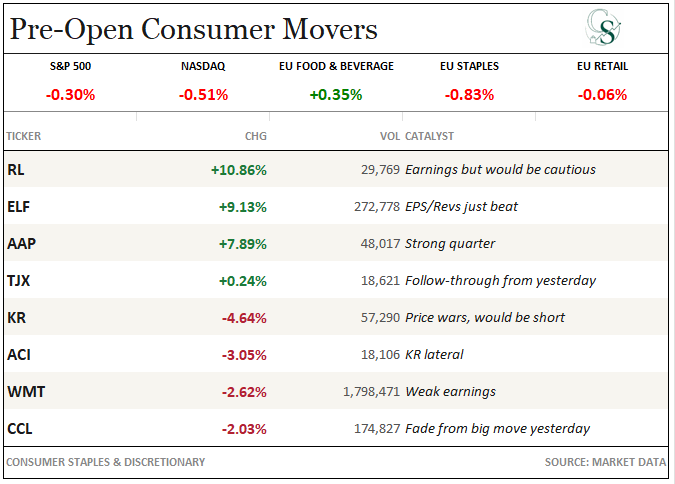
Tape opens defensive as a fuel shock reshapes the consumer narrative. Consumer focus is on WMT (-2.5%) earnings with shares trading lower on an expectations miss (mostly) but bull story still intact with company saying it’s best quarter of share gains in five years (not great for most other consumer companies but also not new). Additionally, a potential price war in grocery space - KR (-4%) isn’t helpful for consumables businesses in general (ex: ACI, SFM + COST, WMT, TGT, BJ, DG). Other earnings for today include ELF (+8%) trading higher on better quarter despite lower guidance. Very quiet on new high signal analyst reports.
STREET RESEARCH
Upgrades
Tractor Supply (TSCO) Raised to Buy at CFRA
Downgrades
Target (TGT) Cut to Hold at Freedom Finance (?) ; PT $130
Initiations
None
Earnings
WMT -2.5%: THE IMMEDIATE HEADLINE IS A LITTLE LIGHT, WITH EPS AND COMP SALES ONLY IN LINE VERSUS EXPECTATIONS FOR A 50 BPS SALES BEAT AND A FEW CENTS OF EPS UPSIDE
2Q is guided a couple percent light on bottom-line and 1% light on top-line. The glass half full is they are saying it’s their best quarter of share gains in 5 years and the comp was negatively impacted by 100 bps from pharmacy pricing legislation.
Goldman:
Would expect the stock down small today on only being in-line (and with the story on KR price cuts), but as WMT points out in the presentation, they are gaining share at the fast pace in many years
The key item that affected results, which seems transitory are fuel expenses:
*WALMART ABSORBED $175M OF OPERATING INCOME IN Q1 DUE TO FUEL
Operating Income growth negatively affected by 250 bps from higher fuel costs in distribution & fulfillment operations (COGS) that WMT opted to absorb to keep prices low for customers.
Morgan Stanley:
The underlying KPI’s of Walmart U.S.’s digital flywheel remain intact: eCommerce sales +26%, advertising +36%, Membership +DD%.
That said, a similar theme keeps repeating: the flywheel’s top-line KPIs continue to outperform, while the corresponding profit flow-through is not outsized.
Fuel expense, which all retailers are dealing with, extracts a penalty from adjusted OI growth so long as energy prices remain elevated.
RL +9%: JUMPS ON STRONG Q4 BEAT, BROAD-BASED COMPS STRENGTH, MARGIN UPSIDE AND SOLID FY27 GUIDE
RL trading +9% after reporting a strong 4Q beat 2.80 vs cons 2.55 on a much better comps 17% vs cons 8.5% with revs 1.98B vs cons 1.85B on broad-based strength.
North Am comp +16%, Europe +5%, and Asia +25%, while adj GM 69.7% vs cons 68.5%, op margin 11% vs cons 10.6%. Mgmt emphasizing healthy quality of sales and balanced growth. FY27 cc rev growth guided to roughly 4%-5% and op margin expansion of 40-60bps.
Options implied 6% move, Call 9am
ELF +9% : RHODE-DRIVEN BEAT, BUT CORE BRAND SLOWDOWN + SOFT FY27 GUIDE REFRAMES THE STORY
I would be careful buying this name as mgmt flagged core ELF-brand consumption decelerating to low-single-digits over the last 12 weeks. Beat-and-lower, with the quality of the beat skewed to Rhode rather than the namesake brand.
1. Key Takeaways
Beat was Rhode-led, not core-led. Total revenue +35% crushed the Street’s ~+28%, but core ELF organic sales (ex-Rhode) were only ~+1%, with units down ~5% offset by pricing/mix of ~+40 pts. The headline masks a soft underlying volume picture in the namesake brand.
FY27 guide is the stock-moving item. Revenue guided to $1.835B–1.865B (~12–14% growth, the weakest in six years) is broadly in line, but EPS $3.27–3.32 is ~9% below Street on continued reinvestment across pricing, innovation, and marketing. EBITDA guide $379–385M is roughly in line.
Mgmt is rolling back pricing to chase volume. Following the August 2025 tariff-driven price increases, mgmt is now selectively cutting prices to repair value perception and drive unit recovery. CEO told CNBC the rollback may not be enough to reignite demand — early elasticity (e.g., Halo Glow price cut) is encouraging, but this pressures margin/profit.
Tariffs (~35% exposure) remain the macro overhang. Gross margin guided roughly flat y/y as pricing/mix offsets tariff headwinds. Potential ~$59M of tariff refunds are NOT in guidance — optional reinvestment fuel if they land.
Rhode + Naturium + international are the offsets. Rhode could exceed ~$500M in FY27 (~+9 pts of growth contribution), with Sephora Europe rollout scaling. Risk: portfolio growth increasingly masks core ELF softness.
Innovation pipeline looks light near-term, which could mute the viral-driven “halo” effect that historically powered the core brand.
2. KPIs vs. Street
Revenue: $449.3M, +35% y/y (last q +38%) vs Street ~$423M, +~28%. Beat.
Adj. EBITDA: $58.8M vs Street ~$50M, +~18% ahead. Margin ~13.1% (down from 24.5% in 4Q25 on heavy SG&A/marketing reinvestment).
Adj. EPS: $0.32 (−59% y/y off $0.78) vs Street ~$0.29. Slight beat.
Gross margin: 72.7% in the quarter (vs 72.7% prior-year Q4 area); guided roughly flat y/y in FY27 as pricing/mix offsets ~35% tariff drag.
Core ELF organic (ex-Rhode): ~+1%, with units −5% and pricing/mix +40 pts — the price/volume mix tension in one line. Consumption now running low-single-digits (last 12 weeks), a clear deceleration.
FY27 revenue guide: $1.835B–1.865B, ~+12–14% vs Street ~$1.864B (in line).
FY27 adj. EBITDA guide: $379–385M vs Street ~$383M (in line).
FY27 adj. EPS guide: $3.27–3.32 vs Street ~$3.61 (~9% below) — the miss that reframes the print.
Inventory: not specifically disclosed in these notes. (No buyside whisper provided in the materials, so vs-buyside comps aren’t available here.)
Note: ELF is multi-brand cosmetics/skincare, not a traffic-and-ticket retailer, so SSS/traffic-vs-ticket comps don’t apply — the relevant analog is units (−5%) vs price/mix (+40 pts) above.
Analyst Actions
Very few incremental notes today..
LOW: HIT WITH BROAD PT CUTS FROM FOUR DESKS DESPITE IN-LINE Q1 COMP; OVERWEIGHT VIEW HOLDS
Lowe’s saw a coordinated round of price-target reductions following Q1, though most desks held constructive ratings. Piper Sandler (Peter Keith) cut to $276 from $300, JPMorgan (Christopher Horvers) to $279 from $325, and Baird (Peter Benedict) to $270 from $320, all maintaining Overweight/Outperform. Wells Fargo (Zachary Fadem) trimmed to $255 from $260, also Overweight. Bull case: Q1 comp was roughly in line, trends improved through the quarter with a positive April exit rate (+0.5% vs HD -0.8%), Q2 is guided better (+1%), PPI levers limit EPS downside, share gains persist, and ~17x NTM P/E looks cheap. Bear case: comps fell short of an elevated 1%+ buyside bar, category visibility is low, and a betting on 2-year acceleration into this macro looks risky.
ANF: HOLLISTER CHANNEL CHECKS SOFTEN, ESTIMATES CUT, PT TO $92 FROM $110
The firm lowers ANF estimates on decelerating Hollister trends, citing channel checks showing slowing store and online traffic, heavier promotions post-F4Q, weak European Softlines read-throughs (EMEA ~16% of sales, with Hollister ~74% of the EMEA store base), and a more value-sensitive Hollister consumer exposed to higher gas prices; A&F checks were favorable and should keep posting higher comps. The analyst flags F1Q GM%/EBIT% below consensus on tariffs (-290bp), ERP (>100bp), marketing (+50bp), and discounting, partly offset by freight (~160bp), AUR, and pricing, though sticky oil reduces confidence in F1H freight benefits and adds GM% surcharge risk.
HRL: STEPHENS LOWERS TARGET TO $22 ON RETAIL MARGIN, PORK AND FREIGHT-COST UNCERTAINTY; STAY SIDELINED
Stephens analyst Pooran Sharma lowered Hormel Foods to $22 from $27, maintaining Equal Weight after a better-than-expected 1Q. The setup has grown more nuanced: Foodservice continues to outperform while Retail margin recovery remains the key proof point. While pricing actions and productivity savings should help, higher pork costs and elevated refrigerated freight could temper the pace of improvement. Turkey fundamentals look favorable — constrained industry supply and strong pricing offer potential upside — though the benefit may be limited by cost-plus exposure and the agreed sale of the whole-bird business. Sharma believes valuation is attractive but sees near-term execution risk, preferring investors wait for sustained Retail margin recovery and improved earnings conversion.
MNST: EVERCORE FLAGS NARROWING PRICE GAP TO RED BULL AS SUPPORTIVE OF PREMIUM VALUATION
Evercore highlighted that Monster Beverage is narrowing its historical price gap to Red Bull, supporting its premium valuation. Monster holds a ~31% volume share versus Red Bull’s ~25.5% YTD, with the two remaining the preeminent energy-drink brands. Crucially, Monster price/mix ran +5.4% in scanner data versus Red Bull’s -2.3% — a 7.7% gap, the widest in five years. Evercore attributes the narrowing premium to improving brand equity from strong innovation, enhanced revenue-growth-management tools, and better bottler/system execution under new management. Monster’s ability to take and hold price above any volume loss is encouraging; the risk is renewed Red Bull promotion shifting the price/volume equation amid cash-strapped consumers.
Macro & News
KR: KROGER CEO PLANS BROAD PRICE CUTS TO CHASE WALMART AND COSTCO ON VALUE
New CEO Greg Foran is preparing significant price reductions across Kroger’s stores to regain share from competitors including his former employer, Walmart. The largest US grocer, operating 21 chains, is developing plans to test and roll out lower prices across categories. Foran likened the business to a Formula One race, aiming to move out of the midfield and “start lapping faster.” He named Walmart, Costco, Trader Joe’s, Aldi and Amazon as value-driven share-gainers. Kroger plans to fund cuts by importing merchandise directly and using technology to reduce expenses, arguing the basket “has to come down” across thousands of products amid cautious, inflation-pressured consumers.
Read-through (ACI): ACI is the key lateral play here and I expect weakness
MORGAN STANLEY CONSUMER CREDIT PANEL: KEY QUOTES
Heather Berger (US Consumer Economist)
On the outlook shift: “We did turn from more optimistic on consumption to now neutral, and that’s really because of the effects of the oil shock that we’re expecting.”
On Fed policy: “We’re now expecting the fed on hold this year, and our inflation forecasts, we do think can allow them to cut in 2027.”
On consumption forecast: “We did lower our real consumption forecast by around 30 basis points. We’re now expecting real consumption at 1.8% and that’s compared to a little bit over 2% last year.”
On the K-shaped consumer: “Low and middle-income consumers will really bear the brunt of the oil shock. They spend a larger share of both their spending and their income on energy and food.”
On what limits the downside: “We’ve seen this $60 trillion wealth accumulation over the past five years for households... that wealth accumulation can continue and support spending from the high income group, and that’s really what’s limiting the downside to our consumption forecast.”
Andrew Parker (US Equity Strategy)
On the earnings/consumer divergence: “We’re seeing something divergent with respect to earnings, which is an early cycle re-acceleration and a near historic rebound in the earnings data.”
On why earnings diverge from consumption: “The consumer contributes 70% of nominal GDP, whereas consumer groups in the S&P 500 contribute about 10 to 15% of market cap.”
On margins: “Over the last year, we’ve seen about 100 basis points of net margin expansion, we think that that trend continues, and it’s really only further accelerated by AI adoption out to 2027.”
On the high-end consumer: “The top 20% of income earners make up 40% of spending in the US, the bottom 20% make up 9% spending, so the high end is still doing quite well.”
On the discretionary-over-staples thesis: “Staples is actually the most negatively correlated, it’s the most sensitive to higher gas prices because it has some of that lower income outsized exposure.”
Jeff Adelson (Consumer Finance Equities)
On the overall characterization: “Normalization is probably the right way to characterize things... we’ve probably normalized above levels pre-COVID. We still are seeing delinquencies running higher than those levels.”
On gas prices vs. tax benefits: “The increase in gas prices are, if it lasts for a year, are going to completely wipe away the tax benefits we’ve seen from the bill.”
On student loans as the weak spot: “Private student loan delinquencies, that’s the one area where we actually have not seen delinquencies improve, they’ve kind of continued to drift higher.”
On the macro vs. lending standards: “What happens in the macro is going to be much more important when it comes to consumer spending and job losses, rather than the banks wholesale driving the consumer off the cliff.”
Carolyn Campbell (ABS Strategist)
On why ABS data looks worse: “Every year we’re hitting new highs in both prime and subprime delinquencies, in subprime in January we crossed the 6% threshold for the first time for 60 day delinquencies.”
On the securitization selection bias (key nuance): “That doesn’t necessarily mean that the same consumer is falling delinquent at a higher rate... it just means that you’ve got this loan that’s in the mix, that all else equal had a higher chance of falling delinquent.”
On issuance: “The ABS market is growing, issuance volumes are up over 30%, over 35% year over year. We’re going to set a new all-time high record of gross issuance.”
On seasonality and stimulus: “We find the most direct relationship between what we would classify as like an acute stimulus... if you distribute money to a consumer, what they’re most likely to do is either save or pay down their debt.”
On the preferred trade expression: “Within the consumer space, right now we prefer to stay within the prime auto space rather than subprime... we think later this year there’ll be a better opportunity to re-enter the subprime auto space.”
On data centers and utility bills: “Most consumers report... feeling that their utility bills are higher because of data centers... but in reality, those price pressures are concentrated in a few key markets.”