Consumer Spec - Pre Market Wrap
AEO (-), COST (-), GAP (-) Reactions | Bifurcated Consumer/Credit Card Delinquencies, XRT Short Squeeze, Redbook Accelerates, Bernstein Conf Color, Cocoa Deflation (MDLZ), Athletic Footwear Share Gain

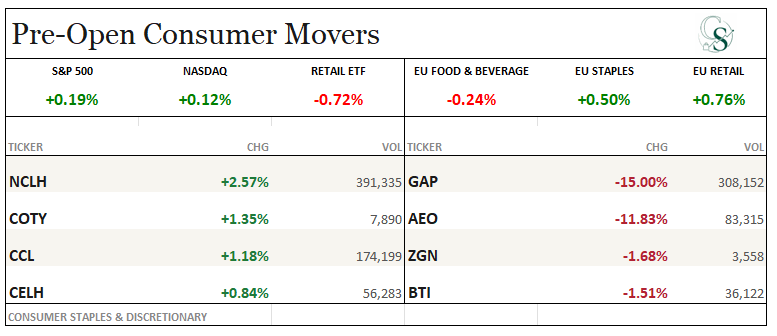
I would guess we experience some give-back today, given AEO & GAP disappointments last night.
Quiet macro tape this morning with retail earnings driving the action. The softline/apparel prints were disappointing with AEO -11%, and GAP -16% — GAP drew a five-broker pile-on after Old Navy’s Q1 miss with JPM and Evercore downgrading, KSS got another PT cut at BofA, and LULU drew a “too early to call a turnaround” from Raymond James. BBY results triggered split views (Telsey up, UBS down, Goldman raised PT but still Sell).
On the positive side, MDLZ reaffirmed as Morgan Stanley’s Top Pick on cocoa deflation, ONON and DECK got Stifel PT hikes off favorable athletic footwear share work, and DLTR lifted at Barclays on better Q1 traffic.
MACRO & MARKETS
INTERESTING NOTES ON THE HEALTH OF THE CONSUMER, POINTING TO A BIFURCATED OR K-SHAPED CONSUMER PROFILE:
Americans are falling behind on their credit card bills at a rising rate according to a WSJ profile article that raises a red flag about the health of the consumer (WSJ)
Soaring interest rates and stubborn inflation have led to highest delinquencies since the financial crisis; ‘a pattern of survival debt’
Americans are saving less – data out Thurs morning showed the savings rate dropping to 2.6% in Apr, down from 3.2% in Mar and 5.8% in the prior year, as consumers struggle to keep up with surging inflation (CNBC)
XRT OUTPERFORMANCE
Remarks from BofA Consumer Desk:
XRT has outperformed by +6% in this 8d time period … and a 7/8 streak like this last happened in late 2022 (+4% over that period) and then 2020 prior to that.
It’s been a fascinating rally, characterized more by short squeeze than real $ demand imo. I’d characterize investor sentiment as less concerned than a few weeks ago about the Consumer, but still “relatively ambivalent” about actually investing in the stocks, to use a buy-side quote I liked from yesterday.
Softline Retail: Popular Shorts outperformed Longs by 10%.
Broadline/Hardline Retail: Popular Shorts outperformed Longs by 9%.
Restaurants: Popular Shorts outperformed Longs by 5%
12 NOTABLE QUOTES FROM YESTERDAY EARNINGS
BEST BUY: “Comparable sales have started strong in May with a month-to-date growth of up high single digits. Our comparable sales outlook for the full quarter is approximately 1% growth as we start to lap last year’s very successful gaming launch in June.”
BEST BUY: “And as we talked about, major appliances is turned to growth in the month of May so far. So we do see it across a lot of categories. But to your point, as we get into June, we are going to start lapping the Switch launch last year, which was roughly $200 million of sales in Q2.”
BEST BUY: “ … we are not seeing any indicators that would say the customer is pulling forward purchases. And in fact, very few really are worried about memory, as I say, in air quotes … we continue to see very consistent customer behavior, which is a customer that’s under a little more pressure, but still resilient, attracted to deals and sales moments, shopping within their budget, which is where our broad assortment really plays in our favor. And while they’re thoughtful about the big-ticket buys, they’re absolutely willing to spend on those high price points when they need to, or when the technology is compelling enough.”
BURLINGTON: “Our sales trend for May, month to date, is tracking at the high end of our comp sales guidance range. That said, our month-by-month comparisons get more difficult as we move through the quarter.”
BURLINGTON: “And when we look at our underlying customer data, the key indicators continue to look positive across demographics and income bands. By the way, we estimate that higher tax refunds in Q1 were worth about 1.5 to 2 points of comp. Even if you strip those out, our comp growth in Q1 was still mid single-digit.”
BURLINGTON: “We see potential upside in Q3 and perhaps in Q4 as we lap easier comparisons in Q3 and as we lap tariff-related assortment gaps in both quarters … we’re perhaps a little more wary now than we were in March, based on higher gas prices and the potential impact on inflation. We’re watching the trend very closely and looking for any change in consumer behavior. We haven’t seen it yet …”
DOLLAR TREE: “Customers are shopping thoughtfully and closer to need with a continued focus on affordability, convenience and trip efficiency. Customers value the ability to shop nearby and quickly to stretch their budgets through smaller and more affordable pack sizes and to still find a compelling assortment and discovery throughout the store …”
DOLLAR TREE: “ … across all income levels, customers are value-focused and definitely prioritizing affordability, you know, convenience and gas saving trip efficiency. In Q1, customers saw higher gas prices for sure, but they also saw higher tax returns. And typically, we see a lag in the true impact from higher gas.”
DOLLAR TREE: “And there’s no question the low-income consumer is under pressure. I mean, we’ve just gone through three or four years of higher inflation generally. Think about food, healthcare, housing utilities … and now on top of that is coming this much higher gas price … all of our cohorts are comping positive in this past quarter.”
KOHL’S: “We continue to see choiceful discretionary spending from our core low to middle income consumer as they remain financially pressured.”
KOHL’S: “Value has always been a cornerstone of Kohl’s foundation. And in today’s macro economy, it’s a necessity for the low-to-middle income that we serve. They continue to seek value in an attempt to stretch their dollars for themselves and their family, when more of their money is being spent on essentials like food and gas.”
KOHL’S: “The health of the customer is great. Payment rates are actually up, interestingly, and our loss rates are down. So the health of that customer, at least from a credit portfolio, looks pretty strong as we move forward to the year.”
Source: Company transcripts via Bloomberg.
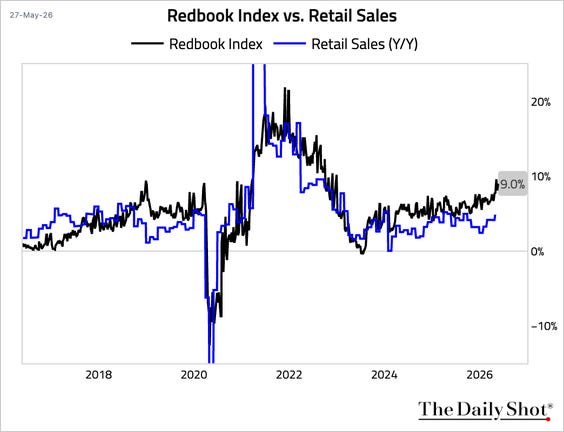
Same-store sales growth accelerated in the latest weekly Redbook report, pointing to a still resilient consumer spending.
This correlates with the positive qualitative tone from CEOs at the Bernstein conf. this week, including from American Express and Mastercard on Thurs (both said consumer spending remains healthy and resilient, a sentiment echoed by Bank America, JPMorgan, Visa, and Wells Fargo earlier in the week).
CONSUMER STREET RESEARCH
Upgrades
Valvoline (VVV) Raised to Neutral at JPMorgan; PT $35
Downgrades
Best Buy (BBY) Cut to Neutral at UBS; PT $86
Gap (GAP) Cut to Inline at Evercore ISI; PT $20
Gap (GAP) Cut to Neutral at JPMorgan; PT $27
Initiations
None
EARNINGS REPORTS
AEO -12% — MODEST TOPLINE BEAT WITH ROTTEN BRAND COMPOSITION: AERIE RIPPING, AE BOTTOMS CRATERING; ’26 GUIDE HELD BUT Q2 OI GUIDE IS A MEANINGFUL CUT.
Expect the stock to react negatively and be heavy during the day
Aerie was better than a high bar at +25% vs Consensus +19% and expectations +21-22%, but it won’t matter given the negative comp at Eagle. Management struck a resolute tone, with efforts already underway to remedy the underperformance, and very early signs that May is improving from what sounded like a turbulent start. However, 2Q operating income was guided well below at $45-$50M vs Consensus $65M (mainly margin driven)
Revenue $1.195B, +9.7% y/y (last q +9.7%) vs Street $1.18B, +~8.3%. Total comps +8% vs Street +8.5% (guide HSD%), but the mix was ugly: Aerie +25% (Street +18%, guide DD%) crushed the bogey while AE went to (2%) (Street +2.9%, guide LSD%), the first negative comp quarter since 2Q25.
Guide setup walks worse: Q2 OI guide $45-50M vs Street $65M, and FY26 OI is now >80% H2-loaded against harder compares.
1. Key Takeaways
AE bottoms (especially women’s denim) drove the (2%) comp miss; mgmt diagnosed it as an allocation/silhouette issue, not pricing. Expected to pressure Q2 (including shorts) before BTS reset.
Aerie strength is broad-based: apparel +45%, intimates +HSD, sleep scaling, traffic/conversion/AOV all up, ~1mn new customers added. Aerie is now structurally carrying the P&L.
FY26 OI guide held at $390-410M despite the AE miss; mgmt offset by raising Aerie outlook and cutting nothing else, but SG&A growth was lifted to HSD% (was MSD%) with no corresponding OI raise — math gets tighter.
Tariff assumptions improved: 10% in Q2, 15% thereafter (vs IEEPA previously); 150-200 bps drag in Q2, easing in H2. Guide excludes potential $140M tariff refund recapture ($190M filed, $100M received, $70M sold for $20M).
May started slow at AE, improved late-month with weather; mgmt sounded confident about inventory cleanliness into BTS but BTS is the proof window, not a current data point.
Inventory +27% in $ (lapping writedown + tariffs), only +5% in units — clean.
COST -0.5% — EPS INLINE ($4.93 VS. $4.93 CONS) ON TOTAL REVS OF $70.53B (VS. $69.68B CONS)
Membership stats from BofA consumer desk:
Costco Membership Statistics.
Global Renewal Rate 89.7% … Flat QoQ
US/CN Renewal Rate 92.2% … Up 10 bps QoQ
Total Membership +4.1% … slowed sequentially (which has been the recent trend)
OVERNIGHT FEEDBACK … some Bears trying to latch onto the Membership deceleration point. And this used be a much louder bear tenet, but back then (not now), the decel was also happening as renewal rates were simultaneously sliding.
1. Key Takeaways
Core merch trends remain remarkably consistent; no tradedown evident, mgmt cited modest price cuts in eggs/beef driving a “+6-7% comp virtuous cycle” in fresh.
Gasoline ripped — most gas sold in company history each of the last 5 weeks; gas revenues +high-20% on price + gallons. This is what drove the total comp gap (+9.8% vs ex-gas +6.8%) and most of the GM ex-membership compression.
U.S. renewal rate inflection is the headline fundamental positive: +10 bps to 92.2%, first up-tick after 4 down quarters. Bears had been pointing to this; mgmt now has rebuttal.
Executive Member growth +9.6% materially outpacing total paid growth +4.1%, confirming continued trade-up. Mgmt explanation of the paid-member drag (warehouse “fill-ins” siphoning from high-volume locations) is consistent with sequential improvement ahead.
AI / retail media optionality showing up: triple-digit growth in agentic LLM traffic, highest conversion of any traffic type, new Google/YouTube retail media partnership. Early but real.
No mention of higher fuel/freight cost headwinds. Tariff refunds expected to be reinvested back into member pricing rather than dropped to the bottom line. Special dividend on the horizon per analyst commentary.
2. Bull vs. Bear Debate
Bulls view COST as the single highest-quality compounder in retail with a self-reinforcing membership flywheel: durable MSD-HSD% comps, >90% renewal rates, accelerating Executive Member trade-up, and emerging optionality in international units, e-commerce, and retail media. The bear narrative from late 2025 (slowing membership, slowing comps, structural model erosion) is being progressively dismantled — comps re-accelerated, renewals inflected, fill-in warehouse drag is rolling off. AI / agentic commerce is shaping up as a real tailwind (COST is the highest-conversion surface across LLMs for majors/appliances). The Google retail media partnership opens a new high-margin revenue stream.
Bears push back on the multiple. At ~48x FY27E and 43x FY28E, COST is already priced for continued perfection and gives back nothing if execution wobbles. GM ex membership compression in Q3 is happening before tariffs/freight peak, suggesting structural pressure as the gas mix grows. Paid member growth of +4.1% remains at the low end of guide despite easier compares, and the 2-yr stack on U.S. comps ex gas decelerated to +14.7% from +15.0% — the first sequential 2-yr down-tick. Ex Executive Member trade-up, core member count growth is decelerating, and the trade-up math doesn’t run forever.
GAP -15% — TOTAL BEAT MASKED BY OLD NAVY’S FASHION MISS; EPS GUIDE RAISE IS COSMETIC (TAX + BUYBACK), NOT OPERATIONAL
Multiple downgrades today in a negative report, expect the stock to trade down.
Total sales $3,497M, +1.0% y/y (last q +2.1%) with total company comp +2% in line; EPS $0.38 in line with VA cons.
Brand mix was the issue: Gap banner +10% (denim, fleece, kids/baby) was a serious print, BR +2% on better product/marketing, Athleta (11%) still mid-turnaround, ON +1% missed the +3% Street expectation that was supposed to benefit from tax refunds. 1Q GM compressed 130 bps on 200 bps of tariff pressure partly offset by AUR and lower discounting at Gap banner.
Guide is negative: cuts net sales, reaffirms margins, not flowing through the benefit of tariff reduction to EPS guide / instead using it to offset fuel and promotional pressures
2. Bull vs. Bear Debate
Bulls see GAP as a structural multi-brand turnaround under Dickson with the Gap banner finally inflecting (+10% comp this quarter is the proof point), Athleta in the early innings of a reset, Banana Republic stabilizing, and Old Navy as the value play for a low-income consumer that ultimately keeps trading down to GAP’s banner. Margin expansion has run ahead of plan, the balance sheet is clean (net cash, -23% net debt-to-equity), and the buyback is now scaling. F26 EPS was raised again. At ~12x forward EPS, GAP trades well below specialty retail comps at 15-18x.
This quarter added the Gap banner blowout (+10%) and tariff favorability; it subtracted ON’s product execution credibility. Bull math: 4-5% revenue CAGR through F28, 100 bps of cumulative OM expansion to ~8.4%, EPS power of $2.80-3.00, at 13x = $36-39, or ~50% upside. Multiple re-rating thesis underwrites another leg of upside if Athleta’s turnaround starts to compound.
Bears counter that Old Navy is ~50%+ of GAP profit and just missed in a quarter that was supposed to benefit from tax refunds, against easy compares. The fashion misses (dresses, shorts, swim) suggest the ON merch process is broken rather than a one-off, and the 2Q/3Q model embeds negative ON comps. The EPS raise was cosmetic — driven by buyback + tax rate, with the underlying op income guide effectively cut. The low-income ON customer is increasingly pressured by gas prices and the slow drip of tariff pass-through. Athleta at (11%) is still a hole. The Gap banner can carry only so much.
This quarter added clear ON deterioration; it subtracted the bull thesis of broad multi-brand momentum. Valuation: at 9x downside FY26 EPS of $2.20 (no further raises) = $20, or ~20% downside. PT cut from $29 to $26 reflects the multiple now deserves the low end of the 4-6x peer range, not the middle.
What changed this quarter: ON went from “expected to benefit from tax refunds” to fashion-execution risk and 2H comp concern; Gap banner momentum re-accelerated to a standout +10%; F26 EPS raise is cosmetic; PT cut $29 → $26 reflects the lower multiple. Net: brand quality bifurcation widened — Gap banner up the league table, ON down it.
ANALYST RESEARCH
GAP: GAP DRAWS 5-BROKER PILE-ON POST-Q1; JPM, EVERCORE DOWNGRADE
Five sell-side firms refreshed GAP after Q1, and the tone skewed clearly negative on Old Navy’s fashion miss in seasonal product. Q1 EPS of $0.38 was roughly in line with consensus, but consolidated SSS of +2% missed +3.1% Street, and 2Q-to-date trends are running below management’s flat-to-+1% comp guide, with Old Navy 2Q-to-date down mid-single digits. Bear case: JPMorgan downgraded to Neutral (PT $27 from $35) on the comp shortfall and unrealistic 2H acceleration baked into guidance. Evercore ISI cut to In Line (PT $20), flagging tax refunds as a 1-2pp tailwind that masked underlying weakness and warning fashion-miss recoveries take time (citing LULU and Athleta as cautionary tales). BofA lowered PT to $26 from $29 (Neutral), Goldman cut to $28 from $32 (Buy), and UBS trimmed to $40 from $41 but stayed Buy. Bull case (UBS, Goldman): management raised FY26 EPS guide to $2.30-2.40, the $400M Q1 buyback was a positive surprise, Aerie momentum is intact, and shares trade around 11x FY26 EPS. Cross-cutting concern: the lower-end customer is under pressure from higher gas prices, with Old Navy specifically exposed. Shares closed at $25.00.
MDLZ: MDLZ MORGAN STANLEY REITERATES OW/TOP PICK, $71 PT; COCOA DEFLATION SUPPORTS POSITIVE EPS REVISIONS
Morgan Stanley reiterated Mondelez as its Top Pick (Overweight, $71 PT), with incremental confidence on resilient above-consensus organic sales growth even as chocolate pricing tailwinds dissipate. The combination of solid OSG and significant cocoa cost deflation supports improving visibility to positive EPS revisions versus consensus, with revisions likely accelerating into 2H26. The analyst views valuation as still too low relative to MDLZ’s earnings visibility and long-term growth profile, even after recent relative outperformance. The setup is described as “an even sweeter setup” — clean read for staples investors looking for a stock with both earnings revisions momentum and structural cost relief. Shares closed at $62.39.
VVV: VVV JPMORGAN UPGRADES TO NEUTRAL FROM UNDERWEIGHT; $35 PT UNCHANGED, VALUATION REACHED FAIR LEVEL
JPMorgan upgraded Valvoline to Neutral from Underweight, PT unchanged at $35. The call is purely valuation-driven: when the firm downgraded near $39 in February 2026, shares were trading at ~12.4x F2026 EBITDA versus a three-year average of 11.8x. The multiple has since compressed to ~11.0x, and the new PT reflects 11.2x F2026 EBITDA. Volume growth has been decelerating as the store network matures, which JPMorgan views as a cap on further multiple expansion. The firm flags potential de-rating risk from raw material inflation as base oil prices rise. Reset to Neutral — no change in fundamental view.
KSS: KSS BOFA LOWERS PT TO $14 FROM $15, UNDERPERFORM; Q1 COMP -1.1%, TURNAROUND UNPROVEN
BofA lowered Kohl’s PT to $14 from $15 while maintaining Underperform. Q1 showed targeted progress — cleaner inventory, better owned-brand traction, and a stabilizing Kohl’s card customer — but comps remained negative at -1.1% with stores comping down LSD. FY26 outlook was unchanged. The improvements are encouraging but not yet evidence of a growth inflection. BofA remains cautious on the durability of the turnaround, citing pressure on the core customer from higher fuel prices as tax refunds wane. FY26 EPS unchanged, FY27 raised 10% on improving loyalty/credit performance. New PT reflects 12x F27E P/E (vs prior 4x F27E EV/EBITDA, standardizing methodology with peers). Read-through to GAP/Old Navy and AEO is consistent — lower-end softlines customer under pressure.
BBY: BBY POST-Q1 VIEWS MIXED; TELSEY $90 OP, UBS DOWNGRADE TO NEUTRAL $86, GS $62 SELL
Three brokers chimed in following Best Buy’s Q1 beat (EPS $1.28 vs $1.23 est) and the stock’s ~17% post-print rally. Bull side: Telsey raised PT to $90 from $80 (Outperform), citing total comps of +2.0% (Domestic +1.8%, International +4.7%), sequential acceleration through the quarter (3% March, 4% April vs -1% February), and 27 bps of OpM expansion to 4.1% on SG&A leverage. Strength was concentrated in computing, mobile, gaming, and emerging categories (AI glasses, 3D printers, gaming handhelds). Bear/cautious side: UBS downgraded to Neutral from Buy (PT $86 from $85), arguing the upside/downside skew is now balanced at ~12x NTM P/E with the stock having absorbed the beat. Goldman Sachs raised PT to $62 from $59 but maintained Sell, flagging that the Q1 benefit was driven by tax refunds, gaming, and computing — much of which is non-recurring or laps tougher comps in June/July. Goldman also warned that rising memory pricing should push computing ASPs higher in 2Q, with potential unit elasticity drag. May-to-date is trending +HSD comps, but appliances remain weak (-13.6% in U.S.). CEO succession is set for November. S
LULU: LULU RAYMOND JAMES MAINTAINS MARKET PERFORM; ‘TOO EARLY TO CALL A TURNAROUND’ AHEAD OF Q1 PRINT
Raymond James reiterated Market Perform on Lululemon ahead of its F1Q26 print, with no PT change. The firm expects a beat on conservative guidance — checks show sequential improvement in foot traffic, website traffic, and Google Trends, though mobile app monthly users decelerated. The January “Get Low” launch landed poorly; checks on “Unrestricted Power” (Feb 10) and “ShowZero” (March 3) are encouraging but not yet game-changing. Estimates may move higher, but a durable turnaround is unproven, especially with a new CEO arriving in September and strategy subject to change. Valuation is optically cheap at 9x P/E, but EPS growth is -6% FY26, +12% FY27.
AEO: AEO UBS CUTS PT TO $31 FROM $35, BUY MAINTAINED; AERIE CALLED UNDERAPPRECIATED GROWTH BRAND
UBS cut its AEO PT to $31 from $35 while maintaining Buy. The thesis still centers on Aerie as one of Softlines’ most underappreciated growth brands, with sales expected to compound at a +14% CAGR over the coming years. The American Eagle brand is expected to be back on track by Back-to-School. UBS isn’t enthusiastic about elevated 1H26 SG&A growth or the 1Q26 inventory level, but views the positives as outweighing the negatives with shares trading around 9x consensus FY26 EPS. Modeling a 24% 5-year EPS CAGR, the firm expects 2H26 fundamentals to positively surprise the market and drive multiple expansion.
ONON: ONON STIFEL RAISES PT TO $60, BUY; #1 ATHLETIC FOOTWEAR SHARE GAINER OVER 5 YEARS
Stifel raised ONON’s PT to $60 from $58 (Buy), naming On as the #1 athletic footwear share gainer over the next five years in its updated category analysis. With 30% global brand awareness, the brand is still underpenetrated in key wholesale channels, and scarcity supports favorable supply/demand dynamics while pushing traffic toward higher-price DTC. Stifel sees On reaching top-5 athletic market share by 2030, supporting CHF 7.5bn in revenue at a +20% 5-year CAGR. Combined with a fundamentally improved margin structure, estimates are biased higher. The new PT is based on 16.5x EV/EBITDA on CY27E adjusted EBITDA of CHF 880mn. Execution risk remains, but the share-gain narrative continues to compound.
DECK: DECK STIFEL RAISES PT TO $144 FROM $140, BUY; HOKA UNDERPENETRATED, +12% 5-YR CAGR
Stifel raised DECK’s PT to $144 from $140 (Buy), citing a favorable setup for HOKA from the same athletic footwear share work that lifted ONON. From a 2.0% global share base, Stifel sees +12% 5-year CAGR in HOKA consumer spend to $4.6bn by FY31E, supported by underpenetration in sporting goods and athletic specialty channels and untapped international brand awareness. Estimates remain above consensus. The new PT reflects 15.0x P/E on FY29E EPS of $9.58. Read-through: athletic footwear category continues to consolidate in favor of brands with running credibility and DTC leverage — ONON and HOKA both gaining at the expense of legacy giants.
DLTR: DLTR BARCLAYS RAISES PT TO $140 FROM $131; Q1 TRAFFIC, GROSS MARGIN BETTER THAN EXPECTED
Barclays raised Dollar Tree’s PT to $140 from $131 (Overweight) following Q1 results, taking estimates above the firm’s own prior numbers. Two key surprises: Q1 traffic was modestly better than Q4 on a 1-year basis and materially better on a 2-year basis, navigating an earlier Easter, weather events, and low-income consumer pressures more cleanly than expected (tax refunds likely helped). Second, gross margin upside is being driven by better-than-expected shrink, which could persist. While there are still 1H transition elements and MPP rollout checkpoints ahead, Barclays sees a credible path to positive 2H traffic and sustainable +3-4% comps, with potential margin upside vs. current guidance.
PLNT: PLNT TD COWEN RAISES PT TO $54 FROM $50, HOLD; SOFT 2026 START DRIVING DECISIVE PIVOTS
TD Cowen raised Planet Fitness’s PT to $54 from $50 while maintaining Hold. The firm acknowledges a softer start to 2026 and slowing relevance with the core TAM as drivers of decisive strategic changes. Management is focused on reconnecting with the ~70% of U.S. adults without a gym membership through a more accessible brand message, while putting price increases on hold (pilots are in motion). TD Cowen appreciates the pivots but wants to see proof points before getting more constructive, with execution and other risks still in balance. Hold maintained — neutral signal rather than a thesis change.
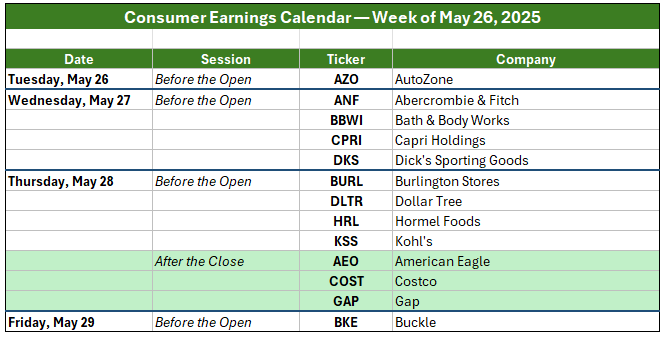
EARNINGS CALENDAR