Consumer Spec Pre-Market Wrap
BRBR (-), VAC (-), HOG, BUD (+) Pre | ULTA Flywheel Upgrade, NCLH Iran Yield Reset, TSN Chicken Strength, CMG Argus Buy, TSCO Dog Ownership Cut, LOW Neutral, TGT Q1 Preview, Hormuz Macro

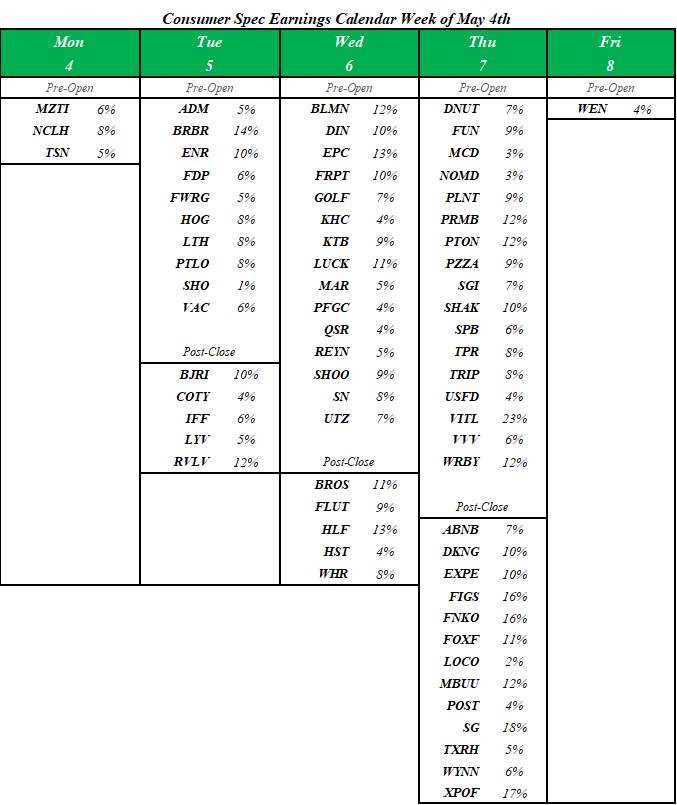
U.S. equity futures are firmer Tuesday morning — S&P +31bps, Dow +20bps, Nasdaq +53bps, Russell 2000 +49bps — as the Iran ceasefire holds, just barely, and Trump's dismissive tone toward Monday's Hormuz flareup keeps deescalation hopes alive. Brent is giving back ~195bps after Monday's 580bp ramp, while the 10-year sits flat-to-down 2bps and gold pushes 85bps higher. Consumer reads cut both ways: AB-InBev smashed Q1 with organic revenue +5.8% and volumes +0.8%, Hugo Boss confirmed 2026 guidance on Asia/Pacific re-acceleration, and Pinterest lit up with sales +18% and MAUs hitting 631MM. Focus today: EU-US trade meeting in Paris, services ISM at 10am (53.7 expected), and a heavy consumer earnings slate including SHOP, PYPL, BRBR, COTY, and RACE.
Consumer Pre-Market Pulse
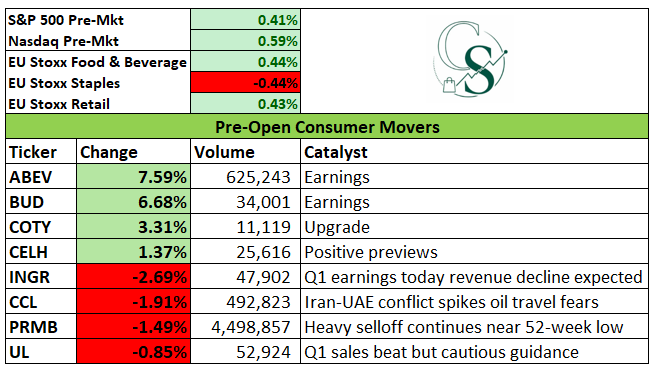
Consumer pre-market is bruised and choppy, with packaged food once again at the epicenter — BRBR is the headline disaster, slashing FY26 EBITDA guide ~25% as RTD shake price/mix collapsed -9.6% on category promo intensity, validating bear fears that pricing power is structurally gone. VAC misses by 47c and trims guide, dragging leisure sentiment alongside NCLH’s Iran-driven yield reset (Barclays cuts to $19). Bright spots: BUD beats handily on volume, TSN sees PT raises across the Street on chicken strength, and CMG lands an Argus upgrade. Honestly, the tape feels like a stock-picker’s market — broad bottom-fishing here is uncomfortable with TSCO dog-ownership cracks emerging. ULTA flywheel call offers rare conviction.
STREET RESEARCH
Upgrades
Ulta Beauty (ULTA) Raised to Buy at Bank of America
Chipotle Mexican (CMG) Raised to Buy at Argus
Downgrades
Lowe’s (LOW) Cut to Neutral at BofA
Tractor Supply (TSCO) Cut to Neutral at Piper Sandler
Initiations
No notable consumer sector initiations today.
Earnings
BRBR F2Q26 — Sales/EBITDA Miss, FY26 Guide Cut Hard on Promo + Inflation
Sales +1.8% y/y vs Street +3.6% (last q tracked above guide); EBITDA $53.8mm vs Street $79.5mm, margin 9.0% vs ~13% guide, hit by ~190bps ($11.3mm) inventory charge on out-of-spec third-party ingredient. Premier Protein RTD shake volume +11.3% y/y (vs +6.1%E) but price/mix -9.6% (vs -2.8%E) as category promo frequency/depth stepped up materially. GM 22.7%, -1,180bps y/y on input inflation incl. tariffs, freight, unfav mix, plus the inventory charge. FY26 guide cut to sales +0-2% (from +4-6%; Street +4.0%) and EBITDA $315-335mm (from $425-440mm; Street ~$422mm), -30 to -35% y/y, embedding promo pressure persisting + incremental protein/freight inflation through year-end; external CEO search ongoing.
1. Key Takeaways
Guide down is the headline, not the print. EBITDA midpoint cut ~$108mm (~25%), implying 2H step-down well beyond 2Q. Mgmt assumes promo pressure + input inflation persist through FY26.
Category dynamics shifted abruptly. RTD protein shake category saw a sharp step-up in volume sold on promo. BRBR participated to defend share — vol +11.3% landed Premier consumption at low end of +3-4% guide — but price/mix collapsed (-9.6%).
Margin pressure is multi-source, not one-time. GM -1,180bps splits across (a) ~190bps inventory charge (third-party ingredient out of spec, non-recurring), (b) protein + freight inflation incl. tariffs, (c) unfav price/mix from promo. Only (a) reverses cleanly.
Mgmt holding ad spend. Brand health metrics still strong; mgmt maintaining advertising despite the EBITDA hit, which one shop reads as prudent positioning ahead of new CEO arrival rather than capitulation.
CEO overhang unresolved. External search still underway; FY26 guide likely set conservatively to give incoming CEO room.
Dymatize -1.9% vs Street +4.7%, adding to the soft segment picture.
Stock setup going in was already poor (price $17.36 vs 52w highs near $80, Barclays PT cut 14-Apr from prior levels, TD Cowen at Hold $17 PT cut 20-Apr from $24). Expectations were muted; this guide goes through the muted bar.
2. KPIs vs. Street
Revenue: $597mm-ish implied, +1.8% y/y (last q +13%) vs Street +3.6%. Miss of ~180bps. Volume: +10.8% vs Street +5.5-6.1%. Beat materially — demand is there at the right price. Price/Mix: -9.0 to -9.6% vs Street -2.2 to -2.5%. Massive miss; the swing factor. Premier Protein segment: +1.7% vs Street +3.3%. Dymatize: -1.9% vs Street +4.7%. Gross Margin: 22.7%, -1,180bps y/y vs Street ~28.4% (-550 to -625bps miss). ~190bps from one-time inventory charge; balance from inflation + promo. EBITDA: $53.8mm vs Street $79.5mm. ~32% miss. EBITDA Margin: 9.0% vs ~13% guide, -390 to -410bps below Street. FY26 Sales Guide: $2,325-$2,365mm, +0-2% y/y vs prior +4-6% and Street ~$2,409mm (+4.0%). Cut. FY26 EBITDA Guide: $315-335mm, -30 to -35% y/y vs prior $425-440mm and Street ~$422mm. ~$92mm cut at midpoint vs Street; ~$108mm cut vs prior guide midpoint. FY26 EBITDA Margin Implied: ~13.9% midpoint vs prior ~17.8% and Street ~17.5%. Inventory: $11.3mm one-time charge flagged; no broader inventory health commentary in the first-impressions notes.
3. Bull vs. Bear Debate
Bulls still anchor on category and brand. RTD protein shakes remain a structurally growing convenient nutrition category, GLP-1 tailwinds support protein consumption, and Premier Protein brand health metrics are reportedly still strong. Volume +11.3% in a quarter where the category went on sale is the bull’s exhibit A — the consumer wants the product, the issue is what they’re willing to pay. Distribution gains, household penetration runway, and innovation pipeline (powder, new flavors, newer formats) remain intact. Bulls also lean on the CEO transition as a reset opportunity and view the FY26 cut as a “kitchen sink” set up for the new leader to beat.
What 2Q adds for bulls: the inventory charge (~190bps of GM, ~$11mm of EBITDA) is genuinely non-recurring; volume strength validates demand; if competitive promo intensity normalizes in FY27, price/mix comps become very easy. Valuation math: bulls model FY27 EBITDA recovery to ~$400mm (ad spend efficiency + promo normalization + inventory reversal), put 11-12x on it for ~$4.4-4.8B EV, net to ~$33-37/share equity — roughly double current. More aggressive bulls argue takeout optionality (TD Cowen flags strategic interest as the biggest upside risk) caps downside at ~$15.
Bears have been winning the tape and this print extends the case. Their thesis: BRBR is no longer a pricing-power story. The RTD protein shake category has matured to where new entrants (private label, branded competitors, adjacent protein formats) force Premier to defend share via promo, and -9.6% price/mix in a single quarter is not a competitive blip but a category re-rating. Once a packaged-food brand starts paying for volume, the GM structure resets lower for years, not quarters. Bears also flag that mgmt is holding ad spend AND cutting EBITDA by 25%+ — meaning the underlying earnings power is even worse than the headline.
What 2Q adds for bears: the magnitude of the price/mix miss (-9.0 to -9.6% vs -2.5%E) is far larger than anyone modeled; FY26 EBITDA guide implies ~13.9% margin vs ~17.8% prior, suggesting the new run-rate margin is structurally lower; protein + freight inflation including tariffs is incremental and may not fade. Valuation math: bears take FY26 guide midpoint $325mm EBITDA, apply 8-9x (peer-group multiple for de-rating CPG with lost momentum, consistent with Barclays’ 8.7x on $434mm CY26E framework but on a lower base) = ~$2.6-2.9B EV, net to ~$13-15/share. More punitive bears argue if FY27 doesn’t recover, multiple compresses further to 7x and stock has a $10-12 handle.
What Changed This Quarter: The debate shifts from “is volume holding?” to “what is the right run-rate margin?” Volume is fine — actually better than fine. Price/mix and GM are the new battleground, and mgmt’s FY26 framework essentially concedes the bear’s structural margin point for at least the next 12 months. The CEO overhang now matters more, because the strategic response (lean into promo, reformulate cost structure, divest Dymatize, sell the company) is the next CEO’s call. Sell-side PTs have been compressing for months (Barclays $50 → $44 → $32 → $30 → $27 → $22; TD Cowen $45 → $37 → $31 → $27 → $24 → $17), and this print likely brings another round of cuts.
5. My Takeaway
Tape reaction: down materially, -10 to -15% on the open, with risk of -20% if buyside whispers were closer to prior guide than Street. This is a clean negative — Q miss, FY guide cut by ~25% on EBITDA, GM structurally lower, no offsetting positive narrative, and CEO seat empty. The only mitigants are (a) stock already at $17 with a busted chart, (b) one-time inventory charge, and (c) volume strength — none of which buys you more than maybe 2-3 points of cushion. Buyside bar was almost certainly below Street given the price action into the print, so part of the cut is “in,” but the magnitude of the EBITDA reset (-$108mm midpoint vs prior guide) is bigger than what was being whispered, and crowded-short positioning won’t save it because the fundamental reset gives shorts a reason to press, not cover.
Actionable view: pass on the long, don’t chase the short here. I’d fade any reflexive bounce in the $16-17 range on day 2-3 if it materializes, but I would not be short into the print after a 75%+ drawdown from highs with a Hold-rated sell-side base and an active CEO search that creates takeout optionality. The right setup is to wait for the new CEO announcement as the catalyst — if they come in and kitchen-sink further (write down Dymatize, reset FY27 base lower), that’s the long entry, likely with a $13 handle. Until then, the stock is a value trap: cheap on a busted multiple, but earnings power is still being marked down. Pair-trade idea for those who need exposure: short BRBR vs. long a category winner with pricing power intact — captures the structural margin re-rating without taking outright takeout risk. Catalysts to watch: (1) CEO announcement, (2) scanner data showing whether category promo intensity sustains into May/June, (3) FY27 setup commentary on the call. Levels: $15 is the YTD low and a logical stop for shorts; $20-21 is the gap-fill for any bounce trade. Pass with a bearish bias; revisit on CEO news.
BUD: AB INBEV TOPS Q1 EPS BY 6C, REVENUE BEATS CONSENSUS HANDILY
Looks very solid with Q1 org. volume +0.8% (vs cons. -0.5%), sales +5.8% (cons +3.0%), org. EBITDA +5.3% (cons +2.6%) and EPS $0.97 (9% beat). Volume beat mainly driven by Middle Americas and South America. N. America vol a touch light but US STRs (depletions) better driven by high 60s growth in Beyond Beer. Strong price/mix in US. EBITDA beat driven by Middle Americas and South America. Outlook reaffirmed, org. EBITDA +4-8% (cons. +5.1%). Stock trades on 16.6x 12m FWD PE broadly inline with EU staples.
Focus on the call will be Mexico/Brazil trends, U.S. share trajectory vs. STZ and TAP, and any commentary on tariff/cost pass-through. Stock setup is constructive given the revenue surprise and recent underperformance vs. global staples peers.
VAC: MARRIOTT VACATIONS MISSES Q1 EPS BY 47C, CUTS FY26 GUIDE BELOW STREET
Marriott Vacations posted Q1 EPS of $1.24 vs. $1.71 consensus — a sizable 47-cent miss — though revenue of $1.26B beat the $1.20B Street estimate. The company guided FY26 EPS to $7.05–$7.80, bracketing but skewing below the $7.57 consensus midpoint. The combination of a soft EPS print with a guide-down in the upper half of the range points to margin/cost pressure rather than demand weakness, given the revenue beat. Read-through is incrementally negative for the timeshare/leisure complex (HGV, TNL) and reinforces the broader cautious tone on cruise/leisure following NCLH’s reset.
HOG: HARLEY-DAVIDSON MISSES EPS BY 1C, BEATS REVENUE, REAFFIRMS FULL YEAR GUIDANCE
Harley-Davidson reported Q1 EPS of $0.22 vs. $0.23 consensus — a one-cent miss — but revenue of $1.1B handily beat the $1.01B estimate. The company reaffirmed FY26 guidance: HDMC retail sales of 130k–135k units, wholesale shipments 130k–135k, HDMC operating income range of -$40mm to +$10mm, HDFS operating income $45–$60mm, and LiveWire losses of $70–$80mm. Capex held at $175–$200mm.
Trends were solid, with global retail sales up +8% (North Am +14%) and shipments ahead of expectations, though shipments declined Y/Y as the company prioritizes lower dealer inventory (-22%). Guidance was reaffirmed. Overall, demand appears healthy—especially in North Am—with improved inventory discipline, though growth remains uneven globally. Options implied 8% move, SI 14%. Call 9am
Analyst Actions
CMG: ARGUS UPGRADES TO BUY WITH 40 PRICE TARGET ON COMP ACCELERATION THESIS
Argus analyst John Staszak upgraded Chipotle from Hold to Buy with a $40 PT. The call hinges on management’s flat 2026 comp guidance proving conservative, with comps expected to accelerate through the year alongside 350–370 new store openings. Argus maintains 2026 EPS of $1.20 and 2027 of $1.35, and is constructive on long-term mid-single-digit comp, high-single-digit revenue growth, and mid-teens operating margin targets. Shares closed $31.98 — the upgrade comes after material underperformance and bakes in a recovery thesis. Read-through is mixed for QSR peers; the call is stock-specific rather than a sector signal.
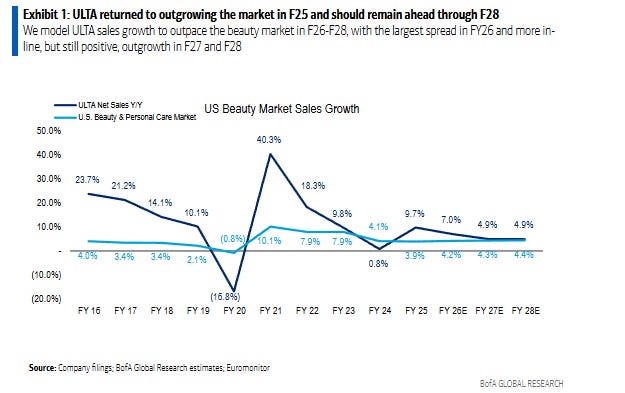
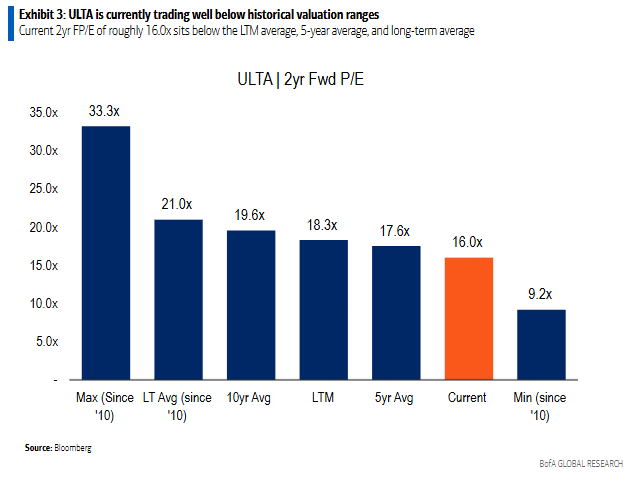
ULTA: BOFA UPGRADES TO BUY WITH 685 PRICE TARGET ON FLYWHEEL FCF MULTIPLE EXPANSION
The firm upgrades to Buy from Neutral with a $685 PO (22x F27 P/E), arguing recent investment is a "flywheel, not a treadmill" and that consistent sales growth with better flowthrough warrants multiple expansion after shares fell 26% off 52-week highs to 16x 2yr forward P/E, the cheapest in its quality-compounder peer group (avg ~22x) and below SPX at 18x. The analyst notes F25 SG&A pressure was largely strategic spend on personalization, supply chain, UB Media/Marketplace, and international, with management's F26 framing of "profitable growth" (sales +6-7%, op income +6-9%, OM +0-20bp) likely the catalyst to shift the debate. F26/27 EPS raised 1%/3% to $28.54/$31.86 to reflect the buyback bump to $1.5B from $1B (~6% of cap), signaling a bigger return-of-capital narrative ahead. The analyst adds the 46.7mn loyalty members (~95% of sales) anchor a defensible moat and reinforce demand durability as the category normalizes and competition intensifies.
Some highlights from the report:
TSN: TYSON PT RAISED ACROSS THE STREET ON CHICKEN STRENGTH, GUIDE RAISE OFFSETS BEEF DRAG
Tyson received PT raises across three brokers following a strong FY2Q print. EPS of $0.87 beat lowered consensus of $0.78, driven entirely by Chicken outperformance and Prepared Foods momentum, partially offset by Beef and Pork shortfalls. Tyson raised FY26 AOI guidance to $2.2–$2.4B (from $2.1–$2.3B) — a $200mm Chicken raise outweighed a $100mm cut to the top end of Beef. BMO (Strelzik) raised PT to $75, reiterated Outperform, and lifted FY26/27 estimates above consensus, citing structural Chicken improvement and Beef plant closure efficiencies building through FY2H26/FY27. Bernstein SocGen (Howard) raised PT to $72 (from $69) at Market Perform, calling results “encouraging” and noting better implied 2H Beef as Lexington closure savings flow through. BofA (Spillane) raised PT to $70 (from $68) at Neutral, lifting FY26/27/28 EPS to $4.20/$4.88/$5.77 (from $3.73/$4.83/$5.74) but staying sidelined on ongoing Beef uncertainty. Bull case: Chicken structurally improved, Prepared Foods momentum, Beef cost-out tailwind into 2H. Bear case: Beef volatility caps multiple, Neutral-rated houses see fair value at current levels. Constructive protein read-through for PPC, JBS.
NCLH: NORWEGIAN CRUISE PT CUT AT MIZUHO TO 24 AND BARCLAYS TO 19 ON DEEP YIELD RESET
Norwegian Cruise saw two PT cuts following a major reset to its outlook. Mizuho (Chaiken) lowered PT to $24 (from $27), maintaining Outperform. Barclays (Montour) cut PT to $19 (from $21) at Equalweight. Barclays’ note was the more cautious — the revised outlook contemplates yields turning deeply negative over the next two quarters driven by: (1) Iran impacting U.S. demand into Europe, (2) Iran impacting domestic travel demand (a new and unique disclosure not heard from peers), and (3) the compounding effect on the NCL brand (~80% of EBITDA), already behind on the booking curve and undergoing a disruptive corporate-level leadership transition. Barclays sees the actions as “right” — urgent shoreside cuts, new marketing/RMS hires, offshoring exploration, AI implementation — but argues the 6–12 month booking curve makes this a long-duration recovery, with no visible turnaround signs yet. Bull case (Mizuho): Reset creates a cleaner setup; corrective actions are appropriate. Bear case (Barclays): Iran headwinds are unique to NCLH, recovery timing unknowable, new leadership unproven. Negative read-through to CCL and RCL on Europe demand softness, though peer commentary has not echoed the domestic demand drag NCLH cited — suggesting company-specific execution issues amplifying the macro.
TGT: OPPENHEIMER PREVIEWS Q1 BEAT, GREEN SHOOTS IN TURNAROUND
Heading into the 5/20 Q1 print, the firm sees scope for an above-Street delivery and the first positive comp since Q424, modeling at least +2.0% vs. Street +0.9% on improved execution, merchandising, stimulus tailwinds, and easy comps. The analyst notes this setup is largely priced in after a 32% YTD rally (vs. SPX +6%, WMT +18%, COST +17%), with shares now at 15.9x NTM, above recent averages but still 0.71x relative vs. 0.91x historical. Despite potential Q1 EPS upside, the firm expects management to reiterate FY26 given consumer uncertainty and higher fuel, setting up beats-and-raises later in the year. Sentiment is constructive on the near-term setup but cautious on sustainability, with consistent LSD comps likely needed to drive further re-rating.
LOW: BOFA REINSTATES NEUTRAL, $260 PT
The firm reinstates coverage at Neutral with a $260 PO (20x F27 P/E) on balanced risk/reward, citing constrained earnings growth (3% 2yr EPS CAGR) without a housing catalyst, with shares at 17x P/E, a 13% discount to HD near a 5-year relative peak. The analyst notes recent ADG/FBM acquisitions are <10% of sales, so DIY (70% of mix) needs to inflect for a more constructive view, though tax refunds may drive 1H comp upside. The leverage point has reset to ~3% from >1%, with op margin modeled -40bp to 11.7% in 2026 (including 30bp ADG/FBM drag), capping multiple expansion absent a return to sustained 3%+ comps. The analyst adds that the comp recovery has been ticket/pricing-driven with transactions down 3-5% for three years, and once pricing laps in 2H26, beating consensus comps looks challenging without DPI, home price, and turnover improvement.
SN: OPPENHEIMER REITERATES TOP PICK INTO Q1
Ahead of the 5/6 print, the firm expects another strong delivery with at minimum an FY26 reiteration, and is nudging Q1 EPS higher on international expansion, innovation, and aggressive US retailer partnerships (notably COST). The analyst notes shares are +3% YTD vs. SPX +6%, with the pullback from 2/17 highs creating an attractive setup given continued double-digit top- and bottom-line growth and ~18x NTM (down from ~23x). The firm flags that buybacks aren’t in numbers and could add up to 5% to FY27 EPS, while shares have risen on 7 of the past 8 prints with notable earnings-day volatility creating dislocation opportunities. The analyst adds less confidence that beats get rewarded this season amid geopolitical/oil and waning tax refund tailwinds, and would use any dips to add.
BIRK: BERNSTEIN SOCGEN REITERATES MARKET PERFORM AND 50 PRICE TARGET ON LUXURY VALUATION GAP
Bernstein’s Luca Solca reiterated Market Perform on Birkenstock with a $50 PT. The note is critical of the brand’s “scarcity-based model” luxury positioning, arguing price points place BIRK far short of Jimmy Choo or true luxury peers. The 1774 collection premiumization push could provide incremental brand building but not a structural luxury re-rate. Solca acknowledges current valuations attribute little credit to BIRK’s cautious growth — but views that as appropriate given the fickle nature of footwear brand heat. Re-rate path depends on accelerating brand heat, which is not yet evident. Shares closed $36.92, well below PT. Mixed read-through to footwear (DECK, CROX, ONON) — implicit caution on premium footwear multiples.
TSCO: PIPER SANDLER DOWNGRADES TO NEUTRAL, PT SLASHED TO 36 ON DOG OWNERSHIP HEADWIND
Piper’s Peter Keith downgraded Tractor Supply to Neutral from Overweight, cutting PT to $36 (from $51). Thesis centers on Companion Animal trends (24% of TSCO sales), specifically structural headwinds to dog adoptions. TSCO flagged Companion Animal as a -100 bps Q1 comp headwind, and Piper expects this to worsen. Cost drivers cited: Vet Services CPI +60% since 2020, Pet Services pricing +46%, Pet Food +25%. U.S. dog population is at/slightly above 2020 levels, and Piper expects households-with-dogs to fall below pre-COVID. TSCO is over-indexed to larger dogs (shorter life spans) — putting it on the leading edge of weakness. Negative read-through for pet-exposed names (FRPT in food, broader pet ecosystem) and for hardlines/farm-and-ranch demand.
Macro & News
INTERESTING MACRO CHARTS
My overall take: Consumer should keep trading heavy while the market prices a longer Hormuz disruption because the setup hits the sector on three fronts: higher oil/gas prices, renewed inflation risk, and weaker discretionary spending expectations. In that environment, investors typically rotate away from consumer cyclicals and travel/leisure names and into safer, less macro-sensitive areas. The key message is not that consumer fundamentals have structurally broken, but that flows are unlikely to return until the market sees a credible path toward Hormuz normalization, lower energy risk, and a more stable inflation outlook.

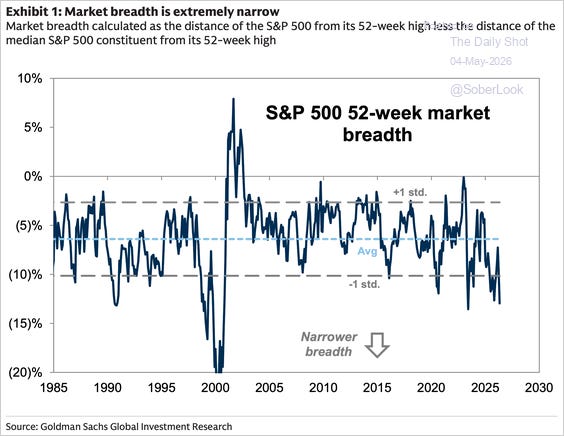
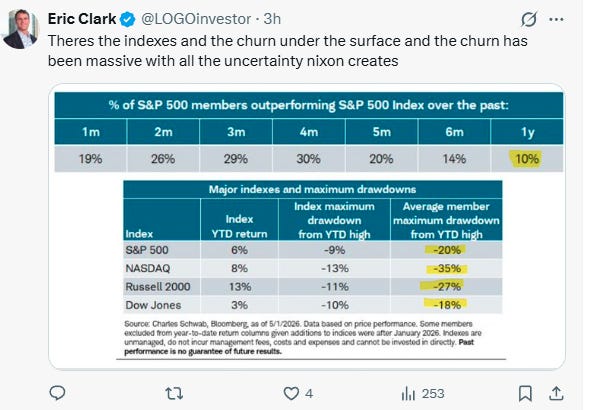
US equity market breadth has narrowed in recent weeks to one of its lowest levels on record
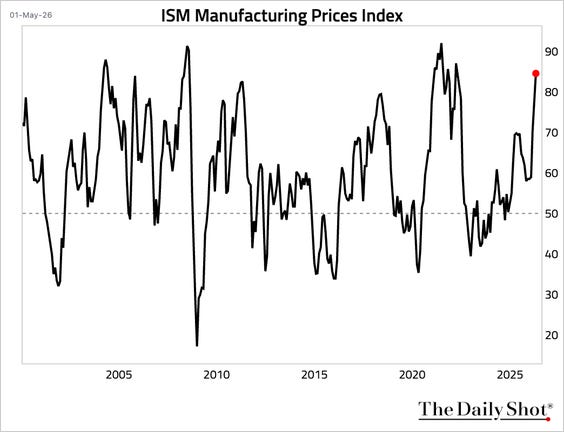
The price index surged to the highest level since early 2022, pointing to significant pipeline inflation
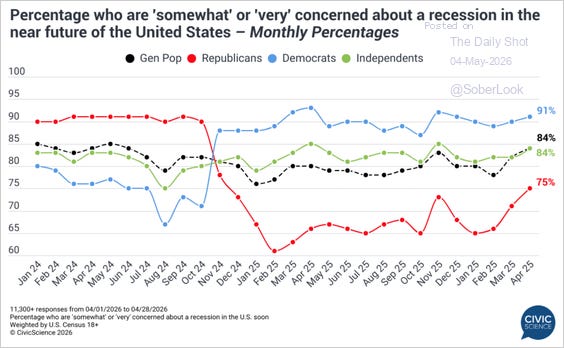
Recession fears have surged to their highest level since mid-2024, according to a CivicScience consumer survey
LVMH is looking to divest certain small, underperforming units as it focuses on its core brands, including Louis Vuitton and Dior (FT)
POOL (Pool Corp.) announced a CEO transition, with John Matwood taking over as head of the company effective today (Matwood joined the company in Jan 2026 and worked at Genuine Parts prior to that).
VSCO (Victoria’s Secret) – BBRC Int’l, a 13% stockholder, pushes shareholders to vote against chair Donna James and director Miriam Naficy.
World Cup economic boost for the US expected to fall far short of expectations (NY Post)