Consumer Spec - Pre Market Wrap
PLAY (-) Sharp Comp Miss | China Retail Sales First Decline Since COVID, Hormuz Reopening Delayed, CAPE Blow-Off Warning, BofA FMS Sell Signal, ELF Haircare Launch, TSCO PT Slashed

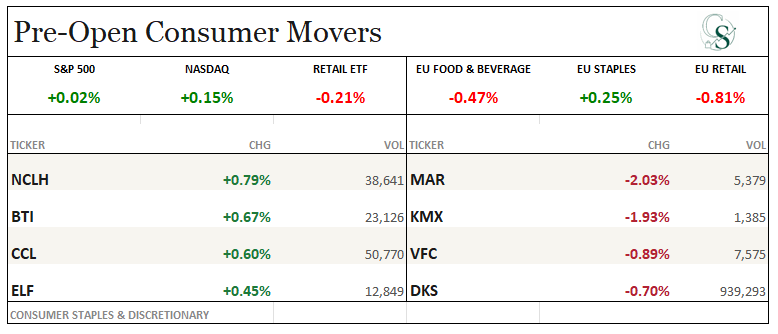
Consumer stocks surprisingly lagged yesterday despite being closer to a peace deal; Our take is that market seems to be in a “wait and see” mode, testing the sustainabiliy of the current deal before truly rotate into sectors like consumer that were negatively exposed to the conflict. This is in-line to this headline:
Hormuz crossings won’t resume for weeks as ship owners wait to see how durable the agreement between the US and Iran winds up being (FT)
Overnight: PLAY -15% on sharp comp deterioration, and China’s retail sales declined for first time since Covid lockdowns which could pressure luxury/other China levered US names (e.g. Tapestry, Capri, Nike, Estée Lauder, Amer Sports, etc). Light on new analyst reports: TSCO PT slashed to $32 at Truist on faltering card data and a shrinking large-dog TAM — that one’s structural, not cyclical. ELF haircare launch well-received (Raymond James, Jefferies bullish), TGT gets Mizrahi nostalgia bid, TXRH screwworm fears overdone per Mizuho. MDLZ taps Banati as CFO (well received by multiple brokers).
MACRO & MARKETS
CHINA’S CONSUMER SPENDING AND INVESTMENT SLUMPED TO LEVELS UNSEEN SINCE THE PANDEMIC, EXPOSING RISKS FOR THE ECONOMY EVEN AS IT BENEFITS FROM BOOMING EXPORTS AND A DE-ESCALATION OF TENSIONS AROUND IRAN
Retail sales declined 0.6% last month from a year ago, posting a worse-than-forecast drop that was their first fall since the reopening from Covid lockdowns in late 2022. Bloomberg flagged LVMH, Kering, Richemont, and Hermès as names to watch in Europe — but the same data is a headwind for any US consumer name with China exposure (e.g. Tapestry, Capri, Nike, Estée Lauder).
MARKET: CAPITAL ECONOMICS WARNS S&P 500 CAPE SIGNALS LATE-STAGE AI BLOW-OFF PHASE
Capital Economics’ John Higgins warns the S&P 500’s cyclically adjusted P/E (CAPE) has risen more than 12 points since the start of 2023 to above 40, with the firm flagging this as a level last seen before the dotcom bubble burst and “one sign that we may be in the ‘blow-off’ phase of the AI-fuelled rally.” The strategist notes CAPE has accounted for just over two-thirds of the S&P 500’s rally since early 2023 and that the firm weights it more heavily than forward multiples, citing skepticism that recent exceptional EPS growth is sustainable, elevated tech capex relative to GDP, and a near-record ratio of equity market value to net domestic worth. The forward 12-month P/E sits near 21 vs. a dotcom peak above 24, and the forward three-year ratio is near 17 vs. a dotcom peak above 22, a less alarming picture through that conventional lens.
GOLDMAN OIL ANALYST: REDUCING OUR PRICE FORECAST ON DEAL TO REOPEN HORMUZ
Following Trump's interim deal lifting the US blockade and reopening the Strait of Hormuz, Goldman cuts Brent forecasts to $80 for 2026Q4 (from $90) and $75 for 2027 (from $80), with WTI at $75 and $70 respectively, assuming Persian Gulf exports normalize by end-July. Supply recovery risks are two-sided, with potential upside from stronger OPEC response and Iran sanctions relief, and downside from renewed hostilities or mining of shipping lanes. 2027 prices remain resilient despite a 3.2mb/d surplus, supported by low OECD stocks, structural stockpiling, and a security premium. Risks remain net to the upside, with an upside scenario of $105 Brent in 2027 if Hormuz stays disrupted, versus a downside of just under $60. See within for more information
MACRO (BOFA): JUNE FMS HITS SELL SIGNAL, LONG SEMIS ALL-TIME CROWDED
BofA’s Bull & Bear Indicator crossed into formal sell-signal territory at 8.9, with sentiment near peak levels despite a modest May pullback; the firm flags long global semis at 80% as the most crowded trade in survey history, up from 73% last month. Rate expectations shifted sharply hawkish ahead of Warsh’s first FOMC, with 40% now forecasting at least one hike (from 16%) and 55% expecting a hawkish hold vs only 33% dovish. The macro backdrop is not benign: 58% describe stagflation as the base case (down from 69% but still dominant), net 45% expect higher global CPI, and rate expectations sit at their highest since Sep ‘22. Equity OW trimmed to 38% from 50% and tech OW dropped to 26% from 33%, but cash at 4.1% still sits below the 5% buy trigger so the cash rule reads neutral rather than contrarian buy; the analyst frames the contrarian playbook as long bonds, Europe, consumer and REITs; short commodities, semis, materials and banks.
CONSUMER STREET RESEARCH
Upgrades
No upgrades in consumer sector today
Downgrades
Dave & Buster’s (PLAY) Cut to Hold at Benchmark
Initiations
No initiations in consumer sector today
EARNINGS REPORTS
PLAY -15%: TOP AND BOTTOM LINE MISS WITH A SHARP COMP DETERIORATION
Comps came in at -5.4% (vs -1.2% cons) while revenue was $559.2M (vs $580.6M cons), pressured by Entertainment revenue of $345.1M (vs $366.2M cons) even as Food & Beverage held in at $214.1M (vs $212.3M cons).
EPS was $0.16 (vs $0.60 cons), with adjusted operating margin of 8.9% (vs 10.3% cons and 12.3% year-ago). Company is guiding to positive comp growth for rest of year but current QTD Q2 comps are tracking down ~4%, tempering credibility of that outlook. CEO Tarun Lal conceded results "fell short of expectations" but flagged the "back-to-basics strategy is gaining clear traction" and reiterated confidence in "positive comps for the remainder of the year while generating over $100 million in free cash flow."
Jefferies reiterates Buy but lowers FY26 SSS to -2.4% (from +0.4%), keeps FY27 at +2.0%, and cuts adj EBITDA to $433m/$469m for FY26/27 (from $470m/$500m) on RLM of 25.8%/26.4%. Management is also cutting unit growth roughly in half in FY27-28 to ~5 new stores annually, redirecting capital toward FCF and debt paydown (still targeting $100m+ FCF this year), which Jefferies thinks will be welcomed by investors focused on the core business.
UBS lowers Dave & Buster's PT to $12 from $13, maintaining Neutral, the firm says 1Q results and commentary highlighted pressured sales trends reflecting worsening macro headwinds in March and April, although trends have improved 2QTD. The analyst notes new remodel prototypes continue to generate ~700bps of SSS outperformance to the system, with ~6 completed in 1Q and two more expected to open in coming months, while unit development guidance of 11 new stores was reiterated and over 30 international franchise agreements have been secured. UBS lowers EPS estimates on pressured 1Q results and lower visibility into a recovery, but sees an eventual return to consistently positive SSS as potential upside given PLAY's attractive margins, solid unit growth, and the $100MM+ FY26 FCF target. The firm frames the name as still in the early stages of a turnaround with macro pressure remaining elevated.
ANALYST RESEARCH & NEWS
ELF: RAYMOND JAMES STRONG BUY, HAIRCARE LAUNCH ADDS NEW VERTICAL
The firm views the launch of e.l.f. Hair, a six-SKU lineup priced $6 to $9 mimicking Color Wow, OUAI, and Olaplex products at ~$30, as a positive category expansion with minimal cannibalization of cosmetics/skin and another execution of the dupes playbook. The analyst expects strong pull from ELF’s core color customer (13% share) and price-sensitive younger consumers amid stressed wallets, though mass haircare is already well-covered so competition will be stiffer than recent primer/lip oil launches. Rollout starts on TikTok Shop tomorrow, elfhaircare.com and Target.com on June 24, and at all U.S. Target stores (ELF’s highest retailer share at 21%) on July 5, supported by a digital campaign and Roblox collaboration. Strong Buy reiterated.
ELF: JEFFERIES POSITIVE ON HAIRCARE ENTRY, $19B TAM AND M&A LEVER
Jeff is positive on ELF’s haircare entry into a $19.3B US mass haircare market (Euromonitor sees the category growing ~24% to $173B by 2030, with 1% mass share equating to a ~$114M revenue opportunity), with the six-SKU lineup (shampoo, conditioner, treatment oil, anti-frizz spray, styling cream, wand) priced at $10 or under sitting in the high-low sweet spot as consumers trade down discretionary spend but sustain treatment spend. Pre-launch proof points read strong: prior styling bundle sold out in 48 hours with 65% new-to-ELF buyers, 96% positive social sentiment, and channel checks pointing the right direction ahead of scanner data. Rollout cadence is TikTok-first June 16, ELF.com and Target DTC June 24, in-store at Target July 5. The analyst views haircare as additive to the fall innovation cycle and a cross-cat engagement driver, with M&A explicitly flagged as the long-term scaling lever.
MDLZ: TD COWEN POSITIVE ON CFO APPOINTMENT, BUY $67 PT
The firm views the appointment of Amit Banati as EVP and CFO effective July 1 as a logical, well-respected hire given his Kellanova track record, prior Mondelez experience, and the similarities between the two companies; CFO/COO Luca Zaramella will continue as COO. The analyst flags that Banati is the third ex-Kellanova executive to take a top packaged food role this year, after Mohit Anand to Campbell’s Biscuits and Nico Amaya to Kraft Heinz North America. The firm says this reflects well on Kellanova’s leadership bench but creates a degree of integration execution risk for Mars. Buy, $67 PT.
GM IS IN TALKS WITH LOCKHEED MARTIN ABOUT MAKING PARTS FOR THE DEFENSE CONTRACTOR’S WEAPONS
The companies are discussing which components GM could potentially make to help Lockheed bolster munitions production. An agreement hasn’t been finalized, and the contours of the arrangement could change, the people said (WSJ link).
CASY: KEYBANK OW INTO INVESTOR DAY, PT $970
Ahead of CASY’s June 24 investor day, the firm expects a three-year outlook anchored on an 8-10% EBITDA growth CAGR through FY29 driven by store expansion, food innovation (wings), and strength in grocery/GM (notably energy drinks), with the analyst believing CASY can exceed this and deliver mid-teens growth in a normal environment given management’s staged-planning history. The firm also expects guidance for 4%+ inside sales (CEFCO remodels, wings, food innovation), expanding EBITDA margins, and continued FCF growth. On macro, with the Iran conflict winding down and oil falling, the analyst argues the fuel margin floor has been raised due to stickier industry behavior, with CY27 comps still better-set than pre-conflict and the NT setup favorable on continued volatility plus declining oil prices. The firm sees NT rotation risk for C-stores but stays OW long-term on store growth and food platform expansion, with $970 PT.
TXRH: MIZUHO REITERATES OUTPERFORM, $190 PT, SCREWWORM COGS FEARS CALLED OVERDONE
Mizuho reiterates Outperform and a $190 PT on Texas Roadhouse, with the firm saying fears around New World Screwworm impact on COGS are overdone and see little risk to 2026 COGS expectations. The analyst notes Q2 checks point to modest SSS growth upside and that sustained beef inflation beyond 2026 should drive continued traffic outperformance as TXRH’s relative value vs. retail beef expands. The firm expects dollar EBITDA growth at least in line with expectations even in a lower-margin scenario. As transaction-led SSS outperformance vs. peers expands through 2026 and into 2027, Mizuho expects TXRH’s relative valuation premium to expand further.
TGT: GUGGENHEIM REITERATES BUY, $145 PT, MIZRAHI PARTNERSHIP BOLSTERS DESIGN PUSH
Guggenheim reiterates Buy and a $145 PT on Target, the firm says the Isaac Mizrahi partnership announcement further bolsters Target’s recent commitment to an elevated portfolio-wide product design process that should drive renewed top-line momentum in discretionary categories. The analyst notes home and apparel have lagged consumables and hardlines despite improved store traffic this year, with enhanced product development and trend-right LTO partnerships being pursued to re-engage consumers. Guggenheim stays Buy as a contrarian call despite significant YTD outperformance, arguing consistent innovation-driven comp momentum could drive multiple expansion from the current 8.4x 2026E EBITDA. The firm frames the return of a talent “synonymous with the halcyon days of Tarzhay” as a positive signal on the brand direction.
TSCO: TRUIST LOWERS PT TO 32 FROM 44, HOLD, 2Q COMP CUT TO MINUS 2% ON CARD DATA
Truist lowers Tractor Supply PT to $32 from $44, maintaining Hold, with the firm cutting its 2Q comp forecast to (2%) from +1.5% based on Truist Card Data showing sales trends faded in the middle of the quarter. The analyst takes FY comp/EPS estimates to (0.7%)/$1.95 from +1.5%/$2.15 and reduces 2H forecasts, arguing trends are too far behind to hit prior expectations for +LSD comps. The firm says TSCO has been hit by a challenging housing/property market and consumer softness, but flags the bigger issues as a falling large-dog population that reduces total addressable market and increased competition from LOW, WMT, and Amazon.
FRPT: PIPER SANDLER REITERATES OVERWEIGHT, $87 PT, COSTCO/KIRKLAND FEARS OVERSTATED
Piper Sandler reiterates Overweight and an $87 PT on Freshpet following meetings with CFO John O’Connor, the firm says concerns about rising competition in fresh pet food, including Costco’s Kirkland brand, appear overdone given FRPT’s broad product assortment and pricing tiers. The analyst notes Freshpet sales at Costco have risen about 45% over the past four weeks, while Q2 U.S. retail sales growth excluding club channels is running at 9.1%, with strong club-channel demand providing potential upside. Piper forecasts revenue of $1.20B in 2026 and $1.30B in 2027 with EPS of $2.11 and $2.64, and expects EBITDA margins to improve through 2026 to 17.5%, aided by new production technology and lower capital spending requirements. The firm also highlights the company’s ad-spend shift from traditional TV toward streaming and digital aimed at high-value customers.
Thanks for reading! If you enjoyed Consumer Spec, we’d appreciate you sharing it.
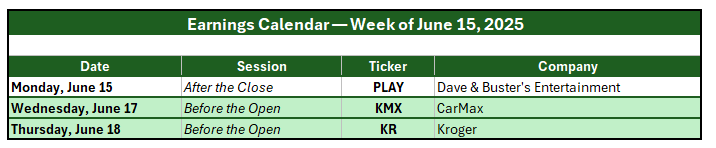
EARNINGS CALENDAR